Lights in the Dusk: Beautiful Beasts at FCN 2006
Aestheticizing the Ugly

As I was seated in Montreal’s Imperial Cinema waiting for the curtain to rise on Tony Gatlif’s Transylvania, I calmly supped upon some pasta salad that I had brought with me. All of a sudden, the woman next to me exclaims: “Just my luck.” Is she talking to me? I don’t see anyone else around here… I turned to her and asked what was up. “I come to the best theatre in the city,” she says, “and the guy sitting next to me is eating pasta salad.” “You don’t like pasta salad?” “I don’t like food in theatres.” Well, this I can understand. But I explained to her that I wasn’t going to eat during the film, and that I had just come from work, had a full evening of screenings ahead, and had no time to sit and eat a proper meal. I guess I could have gone outside with the smokers, but I really didn’t see this as necessary. I’m quiet during screenings, and I pack my garbage out with me. So I finished my meal, though a little unnerved by her energy. As the curtain went up, I leaned over and confessed to her that I had actually been thinking of nibbling a brownie while watching the film but that, for her sake, I would refrain. She assured me that it would be alright, and that, in fact, she had brought some chocolate to nibble on herself. I guess we all draw our lines at different points in the sand.
After the film we talked about it some more and I came to appreciate her opinion very highly. Theatre spaces were sacred to her, like churches and other places of worship and contemplation. You don’t eat in a museum because you have respect for the art. I agreed, but suggested that in a movie theatre the art is not present until the film is on the screen. But the idea that the space of the theatre itself commands respect is one that I like very much. This is an idea that has fallen by the wayside with the dominance of contemporary multiplexes. Indeed, a theatre like the Imperial, with its gothic styling and grand stature, does feel more like a temple than a place of entertainment. I was surprised by her convictions not because I don’t agree with them, but because I’ve never met anyone who felt so strongly about this before. I’ve often been in favour of arriving at theatres early so as to settle in and absorb the space as a kind of preliminary meditation on whatever is about to unfold as the film unspools. This is impossible with music and advertisements blaring at us prior to multiplex screenings, but such is not the case at the Imperial. Such preliminary mediation is exactly what she had come to do, and I spoiled it for her by munching away from the seat next door like I was in a food court. I can understand why she would find this irritating, and her reaction gives me hope that perhaps the cinema has not yet been entirely lost to the snack whores.
Renowned Canadian composer R. Murray Schafer has suggested that people like to eat at the movies because the medium is inherently lacking in its communicative potential. Because there is no presence other than representational imagery and sounds, there is nothing for the audience to connect with, and thus we require external substance to help round out the experience. Needless to say I disagree with his conviction that it is cinema as a medium which has resulted in this propensity towards cinema snacking, but I do agree that something must have gone awry to lead us to this state of affairs. I suggest it is not the medium but rather the quality of the films themselves. I know firsthand that for some films I require popcorn while others I couldn’t think of eating anything that would distract my attention. And I think the same could be said for theatre spaces themselves. Certain spaces, like the contemporary multiplex, demand consumption because it is upon consumption that the space was conceived. Again, the Imperial is no such place, and respectable movie houses like this and the festivals other two venues, Ex-Centris and the Cinematheque Quebecoise, demand to be treated differently. They were indeed conceived to house art, not the consumption of product. So a distinction needs to be made. And I thank my neighbor for reminding me that some people still do have respect not only for films but for the spaces in which they are presented.
Right. Down to business. The theme I’ve latched onto for this year’s festival is that of the beautiful portrayal of ugliness, a seeming paradox that is achieved with such startling regularity that it begs the question posed by John Cage many years ago: When I think of something as being ugly, I must ask myself why I think this. The answer is never forthcoming. For Cage this meant that everything is beautiful, or has the power to be if the right attention is directed towards it. When a filmmaker grapples with unsettling subject matter often associated with the ugliness of humanity, they have the power to reveal that this ugliness is a product only of our perception, and nothing more. By approaching such subject matter with the right attention to detail, films can lift the veil of our preconceptions and challenge us to reconcile the poles of beauty and beastliness as part and parcel of the same thing. All the films I discuss here have achieved this reconciliation to varying degrees.
My festival favourite this year was Aki Kaurismaki’s Lights in the Dusk. It came early in the program and set a tone that I couldn’t help but hold up as a standard throughout the remaining days. Comparing Kaurismaki to Bruno Dumont or other festival darlings is, of course, like comparing apples to oranges. But at a very basic level what I want most out of cinema, art, and life in general is a sense that those I choose to spend my time with exhibit an undeniable passion for life that becomes tangible through their work. This doesn’t mean that I exclusively enjoy films which radiate sunshine and roses. Even some of the most seemingly hopeless and disdainful works of art can be tied to a general positivism that lies at the root of the creative impulse. When I saw Satantango for the first time at the Pacific Cinematheque in Vancouver, BC, someone asked Bela Tarr after the show why he was such pessimist. After all, the film spends no less than seven hours dragging us through the grey, rain-soaked hopelessness of Hungarian rural communities and their struggles to attain some level of comfort in their lives. Tarr answered with something like this: “If I was a pessimist, I wouldn’t have spent 6 months wading through knee-deep mud to make this film and bring it here to you.” Tarr’s films may indeed cut a stark view of contemporary experience in Eastern Europe, but there is something palpably positive about these films that burst through the surface of the screen and touch me on that level where it most counts. Some filmmakers operate out of desire to smack their audiences upside the head, throw us to the ground, and keep on kicking once we’re down in acts of pure nihilistic terrorization. Gaspar Noé, perhaps? But when faced with the very different challenges offered by Kaurismaki and, indeed, Bruno Dumont, there is unmistakable love to be found there. It is this love that keeps me engaged.
Kaurismaki’s latest film is, in many respects, very much like all the others. Finland once again appears rather hopeless, and the key players offer little to suggest that their lives are fulfilling in any way, shape, or form. Yet this tale of a hapless night watchman who gets setup by a local gangster’s moll to take the fall for a jewelry heist is placed within an aesthetic so rich I could hardly contain myself while watching. It was one of those pure, fundamental experiences of a work of art where I’m not thinking about what’s happening and my critical voice is shut down, yet I am not drawn into a compulsive narrative drive or being mesmerized by the spectacular. The film, like its protagonist, sits in a kind of limbo where the colour of a woman’s shirt is as important as what she’s saying to her victim. Not because we’re going to see a flash of red go by on a stretcher and realize that the poor little girl we were made to empathize with in Schindler’s List has died. No, the red shirt in Kaurismaki’s film carries no such direct signification. But a red such as this I have scarcely seen in the cinema, or anywhere else, and that goes for all the colours worn by people, walls, floors, and skies throughout the film. I don’t know how Kaurismaki and his cinematographer achieved the level of attention to surface details in this film, but to have done so in the context of such a bleak tale says something about the filmmakers’ view of their subjects. The people, as is so often the case in Kaurismaki’s films, are expressionless. Why do they even bother getting up in the morning? There seems nothing to look forward to. They might as well just die. And yet the quotidian details of their world are treated with such love that it seems impossible that they aren’t somehow a part of that. A film like this asks us to question the relationship between aesthetics and narrative as much as any that I have seen. If the way a film looks and sounds is inextricably linked to what happens within the story that the film tells, then there is no escaping the fact that the lives of these banal creatures is far from bleak, and that attention to the surfaces of their world can grant us access to the warmth that rests deep within their souls. If dusk is a time when we begin to lose our differentiation between objects within our field of vision, and everything becomes subject to a generalizing murk, then the lights of the film’s title suggest that, against the backdrop of the dark, that which shines brightly stands out all the more. All that, plus the film boasts my favourite of Kaurismaki’s rock n’ roll interludes to date. Watch out for the bar band and you’ll know what I mean.
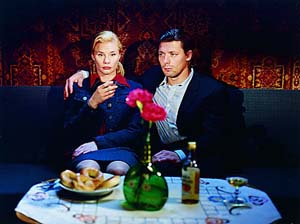
Dumont’s Flandres is a bit of a different beast. Here there seems no conflict between the way the film’s audiovisual aesthetic interacts with its characters, story, and subject matter. Barbe and Demester are a young rural town couple who has passionless, brutish sex and express love for one another most unconvincingly. But this isn’t a story about relationship angst and the difficulties in communication within modern day relationships. Rather, this is a story of an immutable bond that suffers nothing when placed under scrutiny. Why are these two together? Who knows. She, at least, seems interested in more than just this one guy. Gaining a reputation as a bit of a slut, she sleeps with several of the boys in town, one of whom becomes seemingly as important to her as her official boyfriend. The two even co-exist together for some time. While Demester isn’t happy that Barbe is also hanging out with Blondel, the trio still spend time together, and no violence erupts between the men as you might expect from a more conventional treatment of the love triangle scenario. Until the boys go off to war, that is. Amidst the frank and bold portrayal of the horrors of war in an undisclosed desert environment a crucial turn of events takes place. The boys are captured. With the help of an air strike they manage to escape, but while on the run Blondel falls. Demester has the power to help him, but chooses not to. Meanwhile back at home, Barbe is suffering from some psychological distress and is hospitalized. It turns out that she’s having visions of what the men are experiencing, and when Demester returns home she screams viciously “I know what you did!” Yet she accepts him nonetheless, and they resume their relations, now minus Blondel.
And so Dumont gives us his answer to Michael Bay’s Pearl Harbour: a love triangle is solved by the brutality of war. In Pearl Harbour it seems that Ben Affleck was always meant for Liv Tyler, and that other guy was just a stand-in while Affleck was out of commission. Here we get the sense that Blondel and Demester were of equal importance to Barbe, and that there existed the possibility that they might be able to form a relationship forged from outside the boundaries of conventional monogamy. This unconventionality is reflected by Barbe’s ability to think outside the box, if you will. Her connection to these men while they are far away suggests something that belies the frank and grounded nature of Dumont’s style. That there should be something transcendent or metaphysical amidst all this dust, dirt, lust, and practical partnership is somehow bizarre. Yet clearly Dumont doesn’t see these things as irreconcilable. In Humanité, the investigating officer levitates just before his secret is revealed. In Flandres, Barbe has a moment where she tries this same trick, standing high on the tips of her toes, but does not break contact with the ground. But while her feet don’t lose contact, she does indeed leave the ground. She has seen into distant lands, the love she has for her men allowing her the ability to remain connected to them at a distance. And this distant connection is embodied by her levitation attempt. She remains grounded while reaching far out, and this is what makes Dumont’s films so special. They are difficult to endure in their combination of banality and distressing physical relationships, be they violent, sexual, or a combination of the two. But these relationships lead to an expanded knowledge of the world, and lay the foundation for a transcendent cinema that seems anything but. The beastly becomes beautiful indeed.
Speaking of which, Karim Hussain’s La Belle Bête posits a family situation that most would be hard pressed to discover the beauty within. And yet a more passionate exploration of the dark recesses of disturbed youth plagued by compulsive vanity would be hard to find. The consistency in the film’s visual, aural, and emotional tones is an impressive achievement. Hussain shot the film himself, and there’s a warmth to the photography which, combined with a thick grain reminiscent of Kubrick’s forced developing strategies on Eyes Wide Shut, makes for a suitably textured aesthetic environment in which the characters play out their dysfunctions. In a film where an attention starved daughter exacts brutal and violent revenge on her brother, mother, and stepfather, there is fine line between tasteful horror and ridiculous gore. Hussain treads that line with finesse. We were not spared any graphic violence. The daughter in question gives explicit birth by c-section to a daughter of her own. As this scene plays out, we intercut with her brother – poisoned against their stepfather by the bad energy instilled by his sister – chasing the man down with a horse, who ultimately tromps upon his head splitting his skull wide open. These could have been moments that slipped into a B-movie splatter sensibility, but Hussain held the reigns tight and the gore treatment here worked beautifully.
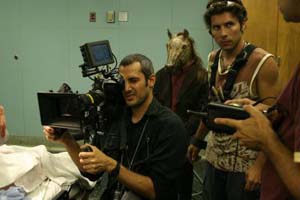
But there is more to this film than just these kinds of graphic outbursts; there is also a consistent psychological element to the film which keeps us wondering, via the recurrent apparition of a man with a horse’s head looming near, if what we are seeing could possibly be happening. Yet only once do we awake with our heroine from a slasher’s dream in which she butchers her family with a carving knife. For the rest of the film we’re left to displace our wondering from, “could” this really be happening to, “why” is this really happening. And surely this is the question the young woman’s daughter asks when, at age 5 or so, she witnesses her mother scorching her uncle with boiling water, and later setting her grandmother on fire, taking the family home down with her. “I do these things because I love you,” mommy responds. It’s a strange kind of love to be sure. But no stranger than the love of cinema that Hussain chooses to express by these seemingly distressing means. The film is well acted, deftly paced, wonderfully shot, and graced with beautiful auditory treatments by David Kristian. While it would have played well at the Fantasia festival, this is not your average outing into the violently deranged. With La Belle Bête Hussain has come into his own. I look forward to what will be coming next.
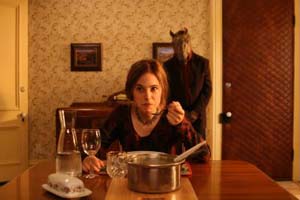
Hussain’s frequent collaborator Mitch Davis also had a film in the festival this year. God’s Little Girl concluded the short program entitled Delirium, and offered a more subdued glimpse into Davis’ flare for horror than you might have found in his earlier produced Subconscious Cruelty. Karim Hussain shot this film as well, but unfortunately Davis could not afford to have a print made so we could only get a sense of the incredible attention to detail on the level of the image track. The film was originally shot on 35 mm, and I believe we were watching it on DVD. Ex-Centris has excellent high definition projection when the source is good, but in this case there was not much to work with. But we make the best of the circumstances that are available to us, and the film definitely made an impression in spite of the conditions. Sombre rooms posit curtains of intense red against pools of outlandish blue light; a roaming camera carves out the psychological space of a woman narrating the death of her one year-old child, an event she comes to terms with by believing that God claims only the pure, leaving the rest of us to rot here on earth over the course of our long lives.
Davis suggested before the screening that the film is a comedy so dark, and played so straight, that he might well be the only one who finds it funny. It definitely played straight to my sensibilities, but that’s not a bad thing. When you push the line between humour and dead seriousness so far to the latter side you have to expect that many won’t find their way back to the other side. In retrospect I can see how aspects of the woman’s commentary could be construed as playfully cynical. Certain lines were indeed absurd, as when she explains that she was once told that when people die it’s because God has lost patience with waiting for them to arrive by his side on their own time. During the end credits Davis dedicates the film to his deceased mother, with the subscript “God lost patience.” I took this as being sweet. Davis said it was supposed to be bitterly funny. Perhaps they’re not so far removed from one another. A film like this demonstrates that our emotions are not so easily categorized as our language might suggest. In this case, it is not a failure on Davis’ part if the audience doesn’t find the film funny. Rather, he offers us the ability to experience humour differently. And not in the usual way of dark comedy, where we laugh even though we’re not sure we should. Davis shifts humour from the level of perception to something embedded within the film itself, and which is there transformed into something else. That something else is an experience of a woman’s psychology through an aesthetic strategy that evokes a line between worlds, somewhere between humour and despair, between the stark contrast of the hottest red and coolest blue you can imagine, between the frank narration and the enveloping soundscape (again by David Kristian). Ultimately the film seemed to place me at odds with myself, a position that, while uncomfortable, demands a level of engagement that can only be prompted by work of this quality.

Pedro Costa’s Colossal Youth ranks amoung the best of the festival’s aesthetic achievements this year, and like the other films mentioned here it binds its aesthetic to its subject matter in a way that forces us to question how what we see and hear has to say about the subject matter of the film. The camera moves but once over the course of the film’s 155 minutes. Every other shot remains fixed from low level and low angle perspectives, with framing that places the dilapidated urban setting of the film towering expressionistically over the people that live within it. Tall structures seem tilted, ready to topple over at any given moment, a feeling enhanced by the loving attention Costas pays to the decay of the materials from which these structures are built. Ventura, a man whose wife has recently left him, wanders between his old neighborhood and his new apartment in a housing complex outside of town. He sits for long periods talking with his friends in dark rooms cast with angular shadows. The film is concerned with the material conditions in which these people live, and their seemingly endless days of uneventful existence. Yet these conditions are exalted by the cinematography. With the camera’s height never rising above a person’s waistline, a more grounded aesthetic would be hard to achieve. And yet this world seems to defy gravity, to exist in spite of itself, a permanent middle ground between erection and collapse. This is perhaps how Ventura feels about his own life, wondering if it will every finally just topple. Indeed, in the film’s final shot he has fallen over on his bed while visiting with his child. Whether or not he’ll get back up is unanswered. Either way, I suspect the world in which he has lived will continue.
When the film’s opening shot appeared on the screen, the distortion created by its extreme low angle was startling, peering up at a concrete building that looked like it had been dislodged ever so slightly by an earthquake. The film was presented 1.33:1, and at the Imperial Cinema the masking does not accommodate this ratio. So, the edges of frame were laid bare, flanked by stretches of blank screen to either side. It immediately became evident that there is a significant keystone problem causing the rectangular frame to appear trapezoidal. The distortion was the worst on the right hand side where the edge of the frame was so angular that its top corner was at least twice as inset from the edge of the screen as the bottom corner. This is the result of the Imperial’s recent renovations which had the projection booth moved from the cinema’s floor to the top of its balcony. The Imperial is a tall space, and the booth is now so high that they simply cannot compensate for the keystoning that occurs when firing downward from such an angle. Interestingly, this effect enhanced the low angle framing of the film, causing already skewed angles to become even more so. At first I was distressed, wondering if, in fact, Costas had intended the crooked angles that permeated his film at every step. And for at least half an hour I constantly surveyed the right edge of the frame, scanning vertical lines in the film to see if they matched the edge of the frame exactly or not. If they did match, then these lines were supposed to be straight and were tilted as a result of the angle of projection. However, in every case it was apparent that these vertical lines did not match the edge of the frame, and were thus intentionally skewed. It’s a good thing that the renovations didn’t require raising the screen up and lowering the projection booth, or else all of Costas’ sharp angles would have been normalized, and his film would have played very straight indeed.
After realizing the extent of the problem with the projection at the Imperial I started to watch out for suspicious angles present in other films. When the films are wide enough that the edges of the frame are concealed by the masking, the problem does not call as much attention to itself. However, as soon as you know what to look for, it becomes immediately evident. For some films it doesn’t really matter. But for others, the distortion plays against the filmmaker’s intentions in unacceptable ways. This was most notable in Tatsushi Omori’s The Whispering of the Gods. The story revolves around a Christian community led by depraved priests at the local school who would regularly molest young boys, and sometimes other species as well. As an aside, it struck me humorous that after almost two hours of watching a steady stream of sexual depravity, one patron finally got up and left as we were treated to a moment of bestiality involving a dog. There was only five minutes left in the film at that point. I guess everyone has their line, but it seems strange that one could remain in the spirit of a film like this for so long and then have that be the last straw. Oh well. The film was certainly deranged, another one of these stunningly beautiful presentations of questionable content. Aesthetically there was something very important about the idea that the Christian way is that of the straight and narrow, yet these spiritual leaders were decidedly crooked. The interiors of the film were all shot dead straight, with none of the expressionistic angles that permeated Colossal Youth. Yet, because of the projection problem at the Imperial, all the walls were leaning inward, creating the impression that the film’s spaces were meant to reflect the interior derangement of the priests who occupied them. It was clear that Omori intended there to be a contrast between the spatial and mental architectures here; the Christian way is supposed to be upright, yet the priests were stooped. This contrast was undermined by the keystoning effect of the projection. I suppose that, for many people, this is a negligible detail. However, I suspect that if an Ozu film were projected under these conditions there would be many a complaint indeed. When a filmmaker goes to great pains to set up shots that deliver right angles wherever possible, you can bet they would be upset to find these angles undone by imperfect facilities. But in this day and age of giant curved screens and stadium seating, I suppose the Imperial’s problem is comparatively minor. Still, it plagued my viewings there for the remainder of the festival.
I managed to forget about the projection quality while watching Invisible Waves, the second offering by Pen-Ek Ratanaruang. Perhaps this was because the film seemed to operate according to a logic governed more by that which we can’t see than what we can. And this is no disrespect to Christopher Doyle’s typically rich cinematography; in fact, Doyle’s treatment of the film’s visual elements creates an environment in which we are free to transcend the image track and access something that lies beyond the surface of the screen. Those who have seen Last Life in the Universe will recognize a similar tone and pacing here, as well as equally beautiful work by cinematographer Chris Doyle. Tadanobu Asanao plays a cook who is instructed to kill the girlfriend of his gangster boss, with whom he happens to be having an affair. The boss then puts him on a boat to get out of town for a while until things cool down. On his journey the cook finds that his boss may have been privy to their affair all along, and that he may be next on the mobster’s hit list. But it is the structure of the film that is most interesting to me, as it is outlined by three occurrences of a distinct offscreen sound: that of the cook vomiting. This may sound distasteful, but in fact it works extremely well to bind the film’s meandering pace to the concrete emotionality of the cook’s response to his own actions. The first instance comes as we are presented with the couple in question having a nice dinner, followed by some “dessert.” At one point the camera drifts away from the pair’s sexual exploits, and we hear a series of sounds that are suggestive of foul play but which remain ambiguous at best. It is not yet clear at this point what has taken place, though with distinctly guttural sounds the suggestion of murder is clearly there. Midway through the film, as the cook sails along on the cruise arranged by his boss, he meets a woman who seems strangely familiar to him. He appears vexed during their initial conversation, and the woman asks him if he’s seen a ghost. Here he rushes offscreen to the side of the boat and expresses some sea sickness, perhaps induced by feelings of regret about what he has done. Whatever the cause, this woman is partly responsible as it later turns out that she is the boss’s current girlfriend. Her connection to the boss seems to have been intuited by the cook, and her appearance thus serves as a kind of flashback to the woman he just murdered. The new girlfriend’s presence is, in some ways , that of a ghost, and the connection between her and the murdered woman is marked by this second instance of the offscreen sound of the cook’s upsurgence. The third instance of offscreen vomiting comes just after the cook has settled in his hotel room upon arrival at his hideout. As he entered the room he was immediately assaulted and robbed by someone waiting for him within. Recovering he sits on the bed, then rushes to the bathroom to vomit once again. Here the sound leads us directly into a real flashback sequence which provides visual details of the murder that was presented only as sound at the beginning of the film. Here we find that these sounds did, in fact, correspond with choking, throat slitting, and the cook’s vomit after the fact. The film comes full circle here, and it is at this point that he will have to confront his actions of the past through an agent of his boss that has been sent there to finish him off. While linear, and possessed of a rather conventional plot, Invisible Waves seems to float on the ether, adhering to a logic all its own.
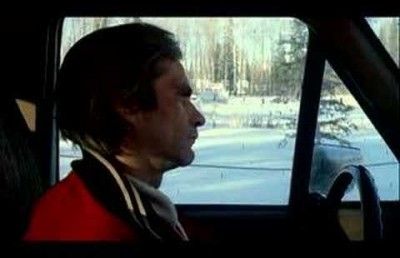
Hakan Sahin’s Snow is the only film that I selected purely on the basis of its description in the newsprint version of the catalogue: “A man and his dog are lost in the snow at an oilfield in Northern Alberta. Beautiful, simple, and poetic.” I never expect a film’s blurb to match what the film itself offers, but in this case the description really led me astray. The film is indeed about a man, Loeffen, and his dog Blackie, but whether or not he’s lost in the snow is wide open to interpretation. I was waiting the whole film for him to get definitively lost as he drove to and from his job at the oilfield, stopping each time in the town of Zama to take meals at the local greasy spoon where he has taken a liking to a cute waitress. Now that the film is done I’m still not sure if Loeffen ever really did lose his way. At first it all seemed a bit hokey to me. Here’s a guy driving his pick-up in a winged winter hat wearing a hoodie and bright orange jacket, talking to his dog in stilted, hoser lingo reminiscent of the McKenzie Brothers. Slowly, however, Loeffen grew on me – just about as slowly as the structure revealed itself to be decidedly non-linear. The film opens with Loeffen swerving into a ditch to avoid hitting something he’s not sure he saw, and then successfully backing out of the ditch with the help of his truck’s four-wheel drive setting. This scenario then recurs at several points throughout the film, and is slightly different each time until, finally, he is not able to get the truck out of the ditch. Between these recurrences we find Loeffen hitting on his favourite waitress, visiting another woman at her work (and being clearly rejected in so doing), and attending the winter solstice party where he tries to get to know a couple of young women above the noise of the blaring music.
Are we to understand these events as separate occurrences upon several trips to Zama, each trip finding him stuck in a ditch along the way? Or are these the events of a single day, broken up by imagined scenarios on the road into town? Or is he really just stuck in a ditch and imagining the whole thing? No answer is given. What the film does provide, however, is an ultimately heart-wrenching portrait of a lonely man, unaccepted by the world in which he lives, searching desperately to connect with someone but not really knowing how that is done. Showing up unannounced to bother a woman you barely know at work is not a good strategy. As for the waitress, we are initially led to believe that she might be feeling similarly harassed by Loeffen’s attention. Yet we discover later that she is rather unhappily married, and has actually been enjoying Loeffen’s visits as relief from her own stagnant domestic situation. Loeffen’s efforts at the solstice party seem initially to be in vain; at one point his conversation with one of the girls is rudely usurped by the appearance of a much younger and hipper boy who clearly has designs on the girl himself. The situation seems hopeless. And then, all of a sudden, we cut to Loeffen and two girls heading to one of their apartments and sharing a joint and some conversation for an extended period of time. If they weren’t interested in him, why would they possibly invite this old guy back to their pad, with the younger suitor now nowhere to be found? Later we cut to Loeffen driving home after his evening out, and it is clear that he did not stay the night with the two girls. But what are we to make of this encounter? Loeffen is convinced that one of the girls really liked him, and he tells his dog about his plans aloud to return and ask her out soon. We are left wondering if he’s delusional, or if there really was some chemistry going on earlier that evening.
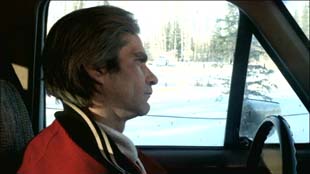
This is so often the question between people who have met each other for the first time, and the film frames the reality of such basic social awkwardness around the potential antisocial perspective that Loeffen has on the world. And it does so in a very subtle manner. Loeffen never seems dangerous, yet clearly there is something not quite right about how he finds his way through his environment. The film concludes with him finally unable to pull himself out of the ditch, and wandering with his dog into the wilderness where he finds a small cabin in which to take refuge. I wouldn’t say he’s lost at this point, but he’s certainly not where he wants to be. And yet this is the most comfortable he’s ever been in the film so far. The cabin’s owner finds him there, and they share a meal, a drink, and some conversation. The man has been living in this cabin since his son went missing in the area while camping some years before. His experience is framed by loss, and the need to reconnect to the world by living at the source of this loss. In an alternate reality Loeffen could be this man’s son, finally returned home after wandering aimlessly for so long. Effectively this is how this scene feels, a moment of peace for Loeffen in a world he really isn’t able to connect to. As morning arrives, he ventures back out into the snow, and finds a reflection of himself there which suggests that he may have finally come to terms with an aspect of his being that has remained indistinct throughout his life. Or he may finally be lost, unable to see what lay ahead, looking outward into the world but seeing only that which lies behind him. While the film is splendidly shot, the film’s quality rests on Loeffen, a man whose general demeanor seems anything but beautiful, but whose relationship to the world points to a longing for beauty that shines back upon him in the form of the inaccessible. Sahin handles this material with grace, and this film, his second, suggests great things to come.
All photos of La Belle Bête taken by Mitch Davis

Randolph Jordan is a Montreal-based film scholar, educator, and multimedia practitioner. His research lives at the intersection of acoustic ecology, film studies, and critical geography. He teaches in the Humanities department at Champlain College, and has previously taught film, media literacy, and environmental philosophy at Concordia University, Ryerson University, Dawson College and LaSalle College. He is co-editor of the Sound, Media, Ecology collection (Palgrave 2019), and his monograph Acoustic Profiles: A Sound Ecology of the Cinema has just been published by Oxford University Press (2023). He has been covering Montreal film, music and new media festivals for Offscreen since 2001.