What is Cinephilosophy? A Bazinian Paradigm, Part 2
André Bazin or, the Cinephilosophical Heritage of Film Studies
In the first part of this essay I attempted to show how reflection on films could itself be a form of fundamental reflection. I based this attempt on an unpedigreed phenomenological experiment in the hopes of being able to establish the credibility of certain assumptions through a dialogue with the reader that actually put them into play. [1] But if my elaboration of the passage from Simone Weil offered a more-or-less expedient analogy for the cinephilosophic conjunction, it deferred any consideration of the historical evidence for this conjunction; we did not properly examine the theoretical basis for using the “real life” example of our experiment as a model for aesthetic experience in the cinema. In this section of the two-part essay I will bring the paradigm I have outlined down to earth by locating it in the history of Film Studies.
Since my model presents philosophy as a possibility intrinsic to any reflection on film we should start (once again) by noting that cinephilosophy must be assumed to already exist dispersed and implicit within the historical record of reflection on film; in one sense it is already incipient in any discussion of film aesthetics. My proposal of the term is designed to activate this potential, to re-orient existing practices and turn them from the equivocal eroticism of traditional aesthetics towards the ethical and political intervention proper to philosophy. The first step in making this turn is to recognize the extent to which it has already been made and in this context I now need to acknowledge that the preceding was only an attempt to restate and extend what I have learned from André Bazin; though the general misunderstanding of Bazin’s work has served to obscure the fact, as I understand it that work has already turned Film Studies in the desired direction. For this reason I believe the most efficient way of recognizing the cinephilosophical heritage of the discipline is to simply correct certain misunderstandings of Bazin’s achievement; once these “smallest details” are properly understood, I believe the entire history of Film Studies springs back into view differently. In this section I will identify some unacknowledged aspects of Bazin’s historical legacy and then show how a correct understanding of Bazin’s ontological argument reveals the cinephilosophical dimension of that legacy.
I will begin by highlighting a problem that emerges as soon as one abandons the conventional distinction between Bazin the Theorist and Bazin the Critic, i.e. the implicit but unjustifiable assumption that divides his work into a “theoretical core” based in the first three essays of What is Cinema? and a largely-unknown “periphery” containing the great bulk of his writings. [2] Even if one confines one’s exploration of this periphery to the fraction available in English translation, one soon discovers a figure whose diverse contributions to the discipline cannot be reconciled with the abstract “theory of realism” attributed to him based on a certain reading of the “core”.
There is the Bazin whose essays “The Western” and “The Evolution of the Western” were among the first historical treatments of film genre and identified key issues that continue to be addressed today. [3] There is the Bazin of “On the politique des auteurs”, whose prescient recognition of “the genius of the [classical Hollywood studio] system” stands at the origin of the examination of that system in the work of Bordwell, Thompson and Staiger, Schatz, Maltby and numerous others. [4] There is the Bazin of “The Death of Humphrey Bogart,” “The Myth of Monsieur Verdoux” and “Entomology of the Pin-Up Girl,” whose bold phenomenological analyses of star images, eroticism and other modes of myth and attraction preceded Roland Barthes’s Mythologies by more than a decade, and Richard Dyer’s Stars by more than three decades. [5] There is the Bazin of “Adaptation, or the Cinema as Digest” and “The Cinema and Popular Art,” who identified the cinema as “an artistic form to complement the accession of the masses to power” and who critiqued bourgeois and romantic notions of the work, authorship and originality long before such Foucaudian and Benjaminian strategies became common currency. [6] Finally, we have the Bazin who created dialogical auteurism, whose monographs on Welles and Renoir and seminal analyses (of Bresson, Chaplin, Rosselini, De Sica, Fellini, Ford, Mann, von Stroheim, Dreyer, Sturges, Bunuel, Wyler, Hitchcock, Kurosawa and many others) established the breadth and flexibility of this approach to the cinema. [7] There are many other aspects of Bazin’s work, but noting the unparalleled range of major achievements above should, I hope, be sufficient to illuminate the basic problem created by the core-periphery schema. Against the backdrop of this manufactured and unnecessary contradiction, I offer a reading of “The Ontology of the Photographic Image” capable of reconciling its argument with the totality of Bazin’s work.
The main task of my reading is to recover the crucial distinction outlined in the following quote:
The quarrel over realism in art stems from a misunderstanding, from a confusion between the aesthetic and the psychological; between true realism, the need that is to give significant expression to the world both concretely and in its essence and the pseudorealism of a deception aimed at fooling the eye (or for that matter the mind); a pseudorealism content in other words with illusory appearances. [8]
Bazin here identifies “two essentially different phenomena that any objective critic must view separately in order to understand the evolution of the pictorial.” [9] This distinction between the aesthetic and the psychological is crucial to understanding Bazin’s use of the term reality which is here explicitly connected to art and the aesthetic. Though the full sense of this connection has yet to be unpacked, as stated it allows me to preview the basic point at which my account will diverge from the standard views of the ontological argument. Despite their differences, all of Bazin’s most prominent interpreters –from his intellectual biographer Dudley Andrew to his would-be nemesis Noël Carroll– have read his argument as claiming that the photograph has, as such and without regard to its aesthetic qualities, a privileged relation to pro-filmic reality that film-makers are prescribed to maintain. [10] As Andrew once put it:
For Bazin the situation was clear: either a filmmaker utilizes empirical reality for his personal ends or else he explores empirical reality for its own sake. In the former case the filmmaker is making of empirical reality a series of signs which point to or create an aesthetic or rhetorical truth, perhaps lofty and noble, perhaps prosaic and debased. In the latter case, however, the filmmaker brings us closer to the events filmed by seeking the significance of a scene somewhere within the unadorned tracings it left on the celluloid. [11]
In a moment we will reconsider some of the textual evidence often produced in support of this position. My immediate concern is simply to observe that nowhere does Bazin argue for the exceptional status of photographic art vis-à-vis the aesthetic/psychological distinction and that, in fact, he deliberately structures the entire Ontology essay around this distinction. Though this feature is not reproduced in Hugh Gray’s translation, Bazin organized the essay into six distinct sections separated by asterixes. Consideration of this structure reveals that he establishes the distinction in the first section of the essay, explores the psychological genealogy of photography in the second, third and fourth sections, examines the aesthetic potentials of photography in the fifth section, and concludes with the famous reversal of the sixth and last section: “On the other hand, the cinema is a language” (my translation of “D’autre part le cinéma est un langage”). [12] In a loose accord with this structure my own comments will deal first with psychology, next with aesthetics, and will conclude with an examination of the reversal and its implications.
The first section of the essay traces the psychological function of art from the mummies of ancient Egypt up to the present, and closes with the following conclusion:
If the history of the plastic arts is not only a matter of their aesthetic but in the first place a matter of their psychology, it is essentially the story of resemblance, or if you will, of realism (my translation and italics). [13]
For our purposes it is essential to note that Bazin reaches this conclusion after acknowledging that “the evolution, side by side, of art and civilization, has relieved the plastic arts of their magic role.” [14] Without denying the processes of desacralization, rationalization and historical understanding that have characterized the development of modern culture, he nonetheless affirms the inescapable role of resemblance in any culture, bluntly asserting that the power of suggestibility we associate with the “primitive” ideologies of the past remains at work in the midst of contemporary illusions of radical human autonomy:
Civilization, cannot, however, entirely cast out the bogy of time. It can only sublimate our concern with it to the level of rational thinking. No one believes any longer in the ontological identity of model and image, but all are agreed that the image helps us to remember the subject and to preserve him from a second spiritual death. Today the making of images no longer shares an anthropocentric, utilitarian purpose. It is no longer a question of survival after death, but of a larger concept, the creation of an ideal world in the likeness of the real, with its own temporal destiny. “How vain a thing is painting” if underneath our absurd admiration for all its works we do not discern man’s primitive need to have the last word in the argument with death by means of the form that endures (the portion of this last sentence in quotes is from one of Pascal’s pensées). [15]
In order to take a full measure of its rhetorical force and intent, I will restate what Bazin is affirming here in a series of polemical propositions:
1. Whether they acknowledge it or not, human beings are attached to mortal things by an erotic or ethical relation.
2. The development of human rationality notwithstanding, this attachment always takes the form of an irrational attraction to the appearances of those things.
3. Its stated motives and historical justifications notwithstanding, all art derives its initial motive and orientation from this irrational attachment to appearances.
It is essential to emphasize the skeptical aspect of Bazin’s affirmations about psychology, his manifest awareness of human vulnerability to illusion and ideology. For Bazin, our receptivity to the world in which we live is inevitably conditioned by the desire we carry with us and by the ideologies that have shaped that desire. This vulnerability is presented as an inescapable constant relevant to the consideration of all art including photography and the cinema. Though Bazin’s interpreters are correct in recognizing his affirmation of the photograph’s relation with Appearance, they mistake his emphasis on the power of Appearance over human credulousness for some form of naive faith. Instead, this emphasis should be seen to reflect a skepticism far more radical than that of any of his critics, for to Bazin the photograph is in the first instance a powerful and ambiguous illusion that defies the critical power of the modern rationality that created it:
… the essential factor in the transition from the baroque to photography is not the perfecting of a physical process […]; rather does it lie in a psychological fact, to wit, in completely satisfying our appetite for illusion by a mechanical reproduction in the making of which man plays no part. […] This production by automatic means has radically affected our psychology of the image. The objective nature of photography confers on it a quality of credibility absent from all other picture-making. In spite of any objections our critical spirit may offer, we are forced to accept as real the existence of the object reproduced, actually re-presented, set before us, that is to say, in time and space. […] A very faithful drawing may actually tell us more about the model, but despite the promptings of our critical intelligence it will never have the irrational power of the photograph to bear away our faith (my italics). [16]
In these quotes and many others we might consider, Bazin’s point is to recapitulate with regard to the photograph the general argument about the psychological basis of art that he made in the essay’s first section; his discussion of the photograph extends his general point that the irrational power of resemblance persists within our enlightened and disenchanted modern civilization. Far from disclosing a pseudo-scientific or mystical “axiom of objectivity,” Bazin’s argument in the first four sections of the essay assumes that all the theoretical edifices of our knowledge – all “the promptings of our critical intelligence” -are as powerless to discriminate between truth and illusion in the photograph as they are in everyday life. [17]
Thus, though it may satisfy our immediate appetite for illusion the photograph does not, in itself, satisfy our deeper appetite for reality. If, for example, we were to imagine that our unfortunate husband finds a certain genre of amateur videotape, we can immediately recognize the hold its images and sounds would have on him: their essential effect would be no different than if he had encountered them “in the flesh”. They would “completely satisfy his appetite for illusion” (unless he is sick he wouldn’t want any more of them) but would not in themselves satisfy his desire for the truth; they might be sufficient to “bear away his faith” (in his wife, himself, the world as he knows it, God, etc.) but would not in themselves produce the process of reflection capable of restoring that faith. This example underlines the impossibility of recovering knowledge of historical experience on the same level as one first encounters its truth; as with any example of cinephilia, the husband could point to the patterns of contingency that concern him, but would find that they mutate or vanish, like sand between his fingers, when he presses them for some truth or certainty. [18] In Bazin’s theory only art can provide us with this, though, as we have already noted, the reality revealed by art paradoxically depends on the more primary psychological fact of illusion. [19]
To understand this paradox we need to retrace its articulation in the essay’s first section. The section closes with the adaptation of a quote from Pascal, the original of which reads: “How vain is painting, which attracts admiration by the resemblance of things, the originals of which we do not admire!” [20] This polemical reference serves to return us to the point earlier in the section where Bazin defines the paradoxical function of art as “sauver l’être par l’apparence” or “to save Being by means of Appearances” (my translation). [21] If the task of art is to fundamentally satisfy our erotic or ethical attachment to the mortal beings that inhabit our world, the quote from Pascal underlines the ambiguous value of resemblance in allowing us to accomplish this task. For Pascal this ambiguity is an inescapable determinant of the human imagination and like Bazin he recognizes the extent to which it defies rationality. As he puts it in another pensée:
It is that deceitful part in man, that mistress of error and falsity, the more deceptive that she is not always so; for she would be an infallible rule of truth, if she were an infallible rule of falsehood. But being most generally false, she gives no sign of her nature, impressing the same character on the true and the false. I do not speak of fools, I speak of the wisest men; it is among them that the imagination has the greatest gift of persuasion. Reason protests in vain; it cannot set a true value on things. [22]
Recasting this ambiguity in terms of the aesthetic/psychological distinction, we might say that in itself the psychological power of resemblance leads us to imaginative relations with both truth and illusion, and that the aesthetic is that faculty which allows us to discriminate between these relations. But when viewed in the context of their common root in desire and the inability of reason to discriminate between them, Bazin’s repeated distinction between the aesthetic and the psychological forces us to track it into another dimension: we are led to posit a qualitative difference in the heart of desire –an inscrutable suspension of our will in a moment of lucid attention– that allows us to distinguish aesthetic achievement from gratifying illusions.
This difference is only articulated later in the essay, in the quote with which we began. Unpacking the full sense of this quote, we find that it distinguishes between a base psychological desire that is “content with illusory appearances” and a higher, stronger, more active form of desire that is only satisfied with true realism, defined as a union of “the Concrete” and “the Essential”. Seen as the process of reflecting on and discriminating between true and illusionary relations, Bazin’s model of aesthetic production presupposes a simultaneous double-mimesis that puts the sensual power of contingent Appearances to work in the service of an invisible or off-screen reality that only a higher or purified quality of desire allows access to. Thus, in the history of painting:
The great artists have always been able to combine the two tendencies. They have allotted to each its proper place in the hierarchy of things, holding reality at their command and molding it at will into the fabric of their art. [23]
It is this process of double-mimesis that is expressed in the phrase “the form that endures” (la pérennité de la forme) which refers at the same time to the persistence of resemblance itself, the formal qualities of art, and the Platonic notion of forms. [24] The work of art thus fuses together two realms, a realm of sensuous immediacy grounded in the power of resemblance, and a realm of Necessity grounded in Being or Truth. With this model in mind, Bazin’s affirmations concerning the aesthetic potentials of photography lose their hyperbolic appearance and simply acknowledge the paradox that the cinema’s singular capacity to produce reflection is rooted in the irrational power of conviction provided by photographic contingency:
Only the impassive lens, stripping its object of all those ways of seeing it, those piled-up pre-conceptions, that spiritual dust and grime with which my eyes have covered it, is able to present it in all its virginal purity to my attention and consequently to my love. By the power of photography, the natural image of a world that we neither know nor can see, nature at last does more than imitate art: she imitates the artist (my italics). [25]
At the root of Bazin’s ontological argument is the assumption that ethics is always at work in the heart of human life and culture, simultaneously securing the illuminations of art and the skeptical awareness of ideology. As the example of pornography demonstrates, any photographic image has an immediate claim on our desire through the power of resemblance; photographic art effects a qualitative transformation of desire that allows us to discriminate between reality and illusion. This process of discrimination is referenced throughout Bazin’s writings, as in this passage from “An Aesthetic of Reality” which illustrates all the main points we have considered so far:
Reality is not to be taken quantitatively. The same event, the same object, can be represented in various ways. Each representation discards or retains various of the qualities that permit us to recognize the object on the screen. Each introduces, for didactic or aesthetic reasons, abstractions that operate more or less corrosively and thus do not permit the original to subsist in its entirety. At the conclusion of this inevitable and necessary “chemical” action, for the initial reality there has been substituted an illusion of reality composed of a complex of abstraction (black and white, plane surface), of conventions (the rules of montage, for example), and of authentic reality. It is a necessary illusion but it quickly induces a loss of awareness of the reality itself, which becomes identified in the mind of the spectator with its cinematographic reproduction. As for the film maker, the moment he has secured this unwitting complicity of the public, he is increasingly tempted to ignore reality. From habit and laziness he reaches the point when he himself is no longer able to tell where lies begin or end. There could never be any question of calling him a liar because his art consists in lying. He is just no longer in control of his art. He is its dupe, and hence he is held back from any further conquest of reality. [26]
“On the other hand, cinema is a language.” This Janus-faced sentence functions as a crucial mediator between Bazin’s ontological argument and the remainder of the essays in the four volumes of Qu’est-ce que le Cinema?. It serves to remind the reader that the process of spiritual struggle I have just sketched out takes place not in some abstract realm but in the historically-conditioned languages and cultures from which the art of the cinema emerges. In a prospective sense it indicates that in the essays to follow the aesthetic achievements of the cinema will only be registered by attending to the historical changes they effect in cinematic language. In a retrospective sense, its blunt qualification of what preceded it reminds us of the dangerous potential for misunderstanding Bazin’s poetic affirmations, which are in fact nothing more than a set of inferences about cinematic potential drawn from the realized facts of cinematic art. In this context the debates between Bazin’s supporters and detractors about the nature of the reality he is referring to misses the point, for the reality revealed by art is the source of all definition or difference and cannot itself be defined; though they have undoubtedly been the cause of much confusion, words such as “realism” and “reality” are in effect only vanishing points at which Bazin acknowledges his inability to “objectively” distinguish between truth and illusion in any given instance of cinematic art. He is well aware that reality is only what we make of it.
What is unique about Bazin’s approach is that the rigour of his skepticism prevents him from subordinating the radical liberty of art to any fixed theoretical framework. If unique conjunctures of linguistic form and historical circumstance are the crucible in which aesthetic achievement distinguishes itself from ideology, if art is the only form of discourse that actually makes a historical difference, then the prime responsibility of film criticism is to use analysis and inference to reconstruct the contexts of film history that makes these interventions possible, not to arrogate to itself the theoretical ability to distinguish art from ideology. On its own terms, Bazin’s strict subordination of theory to the nomadic itineraries of aesthetic experience can claim to have made a more comprehensive and productive intervention in cultural history than all the traditions of ideological critique that have followed him; from his perspective, approaches to film built on theories of ideology are themselves entangled in an “unwitting complicity” that ignores real difference while manufacturing its ersatz. Thus among other things a re-appraisal of Bazin’s ontological argument provides us with a motive to re-consider our discipline’s history and self-understanding.
Bazin’s ontological argument clarifies the theoretical basis for the model of cinephilosophy I have presented and, when properly understood, reveals the philosophical potential of his unacknowledged legacy to the discipline. On one hand, his concept of reality references the irrational conviction that specific patterns of audiovisual contingency can have, a power that we can only infer to be the product of existential contradictions in the spectator’s experience. Considered in isolation, this conviction is what Bazin calls pseudorealism, the irrational and ephemeral allure that as-yet-unexamined contradictions give the photographic image through the power of resemblance; reality in a basic sense refers to the ground of historical experience that is the root cause of cinephilia and to “the reality of the human condition” as always engaged in the process of discriminating between truth and illusion. On the other hand, Bazin’s use of the term also references the new world that appears after one has responded philosophically to an encounter with truth, a world which remains to other eyes and ears (governed by lazier minds and/or weaker qualities of desire) identical to the first but which has been transfigured from within by the liberating effects of true realism or art. If philosophy is a mysterious movement of eros that carries us between two invisible and unknowable worlds, then the art of the cinema registers that movement in a “natural image” that allows us to see it, hear it, and reflect on what it means.
Defined in this manner, my proposal clearly represents a return to the concern with aesthetics that has played a central role in the development of Film Studies as a discipline. It is, however, a return with a difference, one that aims to recover the critical force of cinematic art and use it to create a strong and messy intervention. The ethical and political vocation of cinephilosophy means that it cannot be a manufacturing of novelties to impress the chosen few, just another of the collective monologues of a discipline: it necessarily entails an awkward and unauthorized meddling in other disciplines and domains, the humbling contamination of a genuine dialogue. Though the specific forms of this dialogue will vary in each instance, at this point I can provide a simple illustration of the process that produces such dialogue and hopefully suggest what its benefits might be. To do this, I need to briefly review and clarify the relationship between the concepts of historical experience and reflection that were introduced in the preceding discussion.
The first point to emphasize is that though cinephilia is understood to be produced by the unique historical experience of the spectator, that experience is not taken to be a domain that anyone has direct access to; it is, on the contrary, something that always dispossesses us of the knowledge we have, the world we (really) love transforming the world we (think we) know. [27] Thus in Weil’s experiment we began with a husband secure in his web of expectations and provided him with an experience that ruptured that web. An off-screen reality that he has no prior inkling of shimmers through the scene and reveals his world-view to be inadequate, while the scene itself is experienced as an excess beyond his capacities of representation. The truth of the encounter –its beautiful and productive enigma– does not reside in the specific details in front of him (which may be as ugly as a pile of cigarette butts) but in the dislocation of his entire life, the fact that his understandings of the past and hopes for the future are now put in question. This truth is not a proposition or fact but the effect of a living contradiction, something that makes his discursive grasp on experience unstable and fluid, something that raises certain questions and makes them explicit. The abstract simplicity of Weil’s experiment allows us to infer that this experience of truth is produced at each moment by the husband’s consistent, contradiction-accepting love for his wife, the faculty which accepts the unique contingency of her existence as prior to or greater than any knowledge he might have of her. Beneath whatever intentional activities he may be engaged in (“conceiving, wishing, longing”) one posits an act of attention that simply looks upon the beings he loves, producing thereby an unpredictable series of beautiful effects: before he knows what is happening, his love lifts and holds the “irreducible” contradictions in his life up for reflection. [28]
Having posited this erotic-ethical act of attention as a prerequisite for philosophy’s radical disturbance, it is crucial to recognize the epistemological limit in the inference; though we infer a network of loved beings to provide the motive for reflection, this network cannot itself be the object of reflection. [29] One never knows what one loves because one can never fathom the quality of one’s own intentions. For example, you might be in love with Jean Arthur’s voice and indifferent to your grandmother, yet think you love your grandmother while being cynical and dismissive towards Jean Arthur. [30] In the through-a-glass-darkly world of ordinary experience we live such contradictions more-or-less unconsciously because we lack the detachment to recognize them as such (i.e. because we are attached to the partial conceptions of things put forth in our existing knowledge). By bringing us face-to-face with contradictions in our experience and posing them as questions, philosophy produces a fundamental re-organization of that knowledge, “a change in level” in which the world we know disappears and another takes its place: our existing knowledge gives way to an unstable flux, this flux gives way to the discursive issues of philosophical reflection and, when we “return” from that reflection, we find that the world of objects given in our knowledge has been transformed. [31] Thus though Weil’s anecdote was useful to isolate the root of aesthetic experience in the specifics of human desire, we would be wrong to presume that the wife serves as the main object of the husband’s reflections. [32] One might try to correct this by saying that what the encounter reveals is not the-wife-he-knows but something new that registers as a contradiction against the ground of the-wife-he-knows. But even this is presumptuous, for the truth he encounters can only be identified as the product of an entire web of such loved existences, an indeterminate whole, and cannot be attributed to a specific being isolated as an object of knowledge. The only reasonable inference we can make is that at any given moment our historical experience is formed by a sliding scale of loves and indifferences, a dispersed, unknowable archipelago of contradictions reflected upon and contradictions elided. Due to its fundamental inscrutability, the unique historical experience that can be said to produce cinephilia as a historical fact cannot itself constitute the object of cinephilosophical reflection.
Historical experience only returns to reflection in a different form (and on a different “level”) through the renunciation and humility of a genuine dialogical questioning. [33] Philosophy is not a solitary movement back/down to retrieve a personal collection of component parts (e.g. as in Proust), but is a dialogical process of exploration forward/up towards a more comprehensive view of reality as a whole (e.g. as in Socrates and Plato). It is a movement that deliberately turns from the through-a-glass-darkly world of our unique historical experience to pursue the face-to-face truth of that experience in reflection on the functions of the language we share. The issues that arise in philosophy always transcend their origins because it moves from the existential contradictions that we are compelled to live alone to contradictions in discourse that we can explore together: dialogue allows us to recognize the role of these contradictions in structuring our common experience and thus serves to liberate us from our solitary predicaments. Though Simone Weil presents this experience of detachment and lucidity as an achievement of sanctity (i.e. of a implicit dialogue with God), her description clarifies the role of ethical commitments and self-transformation in any fundamental improvement to our understanding:
It is only by directing my thoughts toward something better than myself that I am drawn upwards by this something. Contradiction is the criterion. We cannot by suggestion obtain things which are incompatible. Grace alone can do this. A sensitive person who by suggestion becomes courageous hardens himself; he may even, by a sort of savage pleasure, amputate his sensitivity. Grace alone can give courage while leaving the sensitivity intact, or sensitivity while leaving the courage intact.
The existence of opposite virtues in the souls of the saints: the metaphor of climbing corresponds to this. If I am walking on the side of a mountain I can see at first a lake, then, after a few steps, a forest. If I want to see both forest and lake, I have to climb higher. [34]
With this metaphor and example in view, we can begin to imagine what it is that cinephilosophy actually reflects on. It identifies and focuses on issues which can be infered to be common to all who share an experience of cinephilia, on those aspects of their experience that transcend the specifics of their historical origins (the infernal hide-and-seek of lived contradictions in which I see the forest but you see the lake, then you see the forest and I see the lake: Plato’s cave) and which can be said to constitute the terrain of reality: the higher ground where our desires become commensurable, where the parts find their proper place in the whole (the top of the mountain, the world outside Plato’s cave). [35] Though cinephilia originates in unknowable private experiences, philosophy can recover the truth of those experiences by reflecting on the discursive issues and contradictions that cinephilia illuminates in the language, culture and history we share.
A final look at Weil’s experiment can provide us with a simple illustration of how dialogical reflection works and can help us remember what we are actually doing when we are in the process of cinephilosophical analysis. We can begin by noting that the shimmering contingency or excess in front of the husband can be represented as a movement of equivocation between a swarm of possible explanations for what he sees, or, in more general terms, as a moment of hesitation or undecidability between several discursive regimes. In taking a philosophical response to the excess of the encounter he holds onto all the elements of the contradiction it reveals, i.e. the arguments of these discursive regimes, and systematically brings them into a face-to-face confrontation or dialogue. If, for the purposes of analysis, we reduce the discursive regimes in play to those associated with his wife, we can immediately recognize the painful labour of true love, the paradoxical combination of courage and sensitivity, the climb, this dialogue entails, as he struggles to reconcile the arguments in favour of his long-term confidence in his wife (the forest) with the discourses that elaborate her duplicity (the lake). But as he persists in staging this conflict, and as each of the discourses is forced to prove its fitness by presenting its evidence, defining its terms, clarifying its frames of reference, et cetera, a curious but inevitable transformation of the issues takes place: instead of walking in circles around the mess of his particular marriage, he finds himself reflecting on the general bases for any marriage, on the differences between marriage and passion, and on the conflicting demands and proper hierarchy of various human needs. While on one level he still thinks he is struggling with a contingent geometry problem involving his wife, her lover and himself, on another he is ineluctably gaining philosophic insight into aspects and possibilities of human nature that are common to all three of them. When he finishes thinking about these general issues and returns to consider his personal situation he discovers that he has a better understanding of all the parties concerned; everything remains the same but at the same time it all looks different. Though the problem he started with has not been solved, it no longer seems to matter, he has difficulty remembering why it bothered him and, finally, it is simply gone. And though that problem no longer makes sense to him, many other things do: as distant as his wife may now be, and though he feels he may never possess her again, the husband nonetheless feels closer to her than he ever has before because she is better situated within a more comprehensive understanding of reality as a whole.
Philosophical dialogue thus creates a beneficial revolution at the most intimate level where language engages and structures our historical experience. Its form of reflective confrontation sets the words and concepts we use spinning on their axes until they arrive at new configurations that make better sense to and for all concerned. It fixes on what our aesthetic experience tells us we already care about and then systematically forces us to prove we really care. In the course of that demonstration we discover what we really care about (reality) and are liberated from what does not exist (ideological illusions).
All of the preceding was designed to present a paradigm of cinephilosophy with a broad appeal, a fable of the possibilities capable of sponsoring genuine and effective dialogues within Film Studies. My rough-and-tumble phenomenology presented a very long and complex process from only two angles: a long shot from initial impetus to final benefits, and a close-up on a set of assumptions that account for the genesis of aesthetic experience. While there are other close-ups we could take (e.g. of the dialectical movement from existential to discursive contradictions), it is beyond the scope of my study to recapitulate a general model of the process in full detail; at this point I can only hope that the summary I have provided is suggestive enough to tap into existing understandings of the philosophic process. [36] Though I cannot objectively justify my assumptions regarding the place of eros, ethics and art in human experience, I rest my case with the assertion that the preceding account provides a coherent explanation for three things we already take for granted whenever we discuss films: the possibility of fundamental reflection in general; the facts of cinephilic phenomena; the possibility that reflection on the cinema can itself constitute a form of fundamental reflection.
Endnotes
1 While my conception of cinephilosophy is in fact indebted to a considerable number of individuals and traditions that I might have named, I chose not to foreground this genealogy in the hope of being able to launch it as a generic paradigm, i.e. as an approach that could address and satisfy the desires of anyone interested in films; though specific references can obviously help secure the collective understanding of an argument, they can just as easily provoke misunderstanding and division, and I thought it worth holding the good/bad magic of a genealogy at bay until I had made a more direct appeal to the historical experience of the reader. One only has to ponder the function of the names “Lacan,” “Cavell” and “Deleuze” within the field of Film studies to realize how the source of one scholar’s joy can provoke nausea in another.
2 This three core essays are: “The Ontology of the Photographic Image,” “The Myth of Total Cinema” and “The Evolution of the Language of the Cinema” in André Bazin, What is Cinema? Volume I (Berkeley, University of California Press, 1967). Because it makes its own flaws explicit, Noel Carroll’s argument for the core/theory-periphery/criticism distinction constitutes the most compelling argument against it in print. Noel Carroll, Philosophical Problems of Classical Film Theory (Princeton, N.J.: Princeton University Press, 1988).
3 “The Western: or the American Film Par Excellence,” “The Evolution of the Western” in André Bazin, What is Cinema? Volume II (Berkeley, University of California Press, 1971). The proof of this claim is manifest in Jim Kitses and Gregg Rickman, eds. The Western Reader (New York, Proscenium, 1998), an anthology which includes “The Evolution of the Western” and where the categories laid out by Bazin are developed in all of the later contributions. Altman’s comprehensive exploration of the inherent dialogical tensions in genre films in Rick Altman, Film/Genre (London, BFI, 1999) were already examined by Bazin in this essay.
4 André Bazin, “On the politique des auteurs” in Jim Hillier, ed. Cahiers du Cinéma: The 1950’s: Neo-Realism, Hollywood, New Wave (Cambridge, Harvard University Press, 1985). David Bordwell, Janet Staiger, and Kristin Thompson, The Classical Hollywood Cinema : film style & mode of production to 1960 (New York : Columbia University Press, 1985); Thomas Schatz, The Genius of the System: Hollywood filmmaking in the studio era (New York : Pantheon Books, 1988); Richard Maltby, Hollywood Cinema (Malden, MA : Blackwell Pub., 2003).
5 André Bazin, “The Death of Humphrey Bogart” in Jim Hillier, ed. Cahiers du Cinéma: The 1950’s: Neo-Realism, Hollywood, New Wave (Cambridge, Harvard University Press, 1985); “The Myth of Monsieur Verdoux” and “Entomology of the Pin-Up Girl” in What is Cinema? Volume II (Berkeley, University of California Press, 1971). Roland Barthes, Mythologies (New York, Hill and Wang, 1972); Richard Dyer, Stars (London: BFI, 1979).
6 “Adaptation, or the Cinema as Digest” in André Bazin, Bazin at Work: Major Essays and Reviews from the Forties and Fifties (New York: Routledge, 1997) 47; “The Cinema and Popular Art” in André Bazin, French Cinema of the Occupation and Resistance: The Birth of a Critical Esthetic (New York: Frederick Ungar, 1984).
7 André Bazin, Orson Welles: A Critical View (New York: Acrobat Books, 1992); Jean Renoir (New York: Da Capo, 1992). Essays on Bresson, Chaplin, Rosselini, De Sica, Fellini, Ford, and Mann are found in the two volumes of What is Cinema?; essays on von Stroheim, Dreyer, Sturges, Bunuel, Hitchcock, Kurosawa are found in André Bazin, The Cinema of Cruelty from Bunuel to Hitchcock (New York: Seaver Books, 1982); an essay on William Wyler can be found in Volume 1 of the French Qu’est-ce que le cinéma.
8 André Bazin, What is Cinema? Volume I (Berkeley, University of California Press, 1967) 12.
9 André Bazin, What is Cinema? Volume I (Berkeley, University of California Press, 1967) 11.
10 Dudley Andrew, André Bazin (New York : Oxford University Press, 1978); Dudley Andrew, The Major Film Theories: An Introduction (London ; New York : Oxford University Press, 1976); Noel Carroll, Philosophical Problems of Classical Film Theory (Princeton, N.J.: Princeton University Press, 1988). Though Andrew’s account of Bazin’s intellectual formation and exposition of his phenomenology in the biography and later essays does in fact yield a picture of cinephilosophy similar to my own, the received view of Bazin’s work within the discipline seems to be based on the more summary presentation of Bazin’s work in The Major Film Theories, i.e. a presentation that has left it open to unjustified critiques.
11 Dudley Andrew, The Major Film Theories: An Introduction (London ; New York : Oxford University Press, 1976) 145.
12 André Bazin, “Ontologie De L’Image Photographique” in Qu’est-ce Que Le Cinéma? I: Ontologie et Langage (Paris: Les Editions Du Cerf, 1958) 19.
13 André Bazin, “Ontologie De L’Image Photographique” in Qu’est-ce Que Le Cinéma? I: Ontologie et Langage (Paris: Les Editions Du Cerf, 1958) 12.
14 André Bazin, What is Cinema? Volume I (Berkeley, University of California Press, 1967) 10.
15 André Bazin, What is Cinema? Volume I (Berkeley, University of California Press, 1967) 10.
16 André Bazin, What is Cinema? Volume I (Berkeley, University of California Press, 1967) 12-14.
17 The notion that all of Bazin’s work can be reduced to such an axiom seems in general to emanate from a misreading of Eric Rohmer’s argument in “André Bazin’s Summa” in Eric Rohmer, _The Taste for Beauty- (New York: Cambridge University Press, 1989).
18 Cf. Willemen’s characterization of cinephilia in note 28 above.
19 Every undergraduate presented with the received view of Bazin’s ontological argument always wonders why Bazin does not in any way privilege the documentary; the account I’m presenting here recognizes that aesthetic or ideological concerns always structure our perception of real events in the same way aesthetic or ideological artifacts structure our perception of fictional events.
20 Blaise Pascal, Pascal’s Pensées (New York: Modern Library, 1967) 38.
21 André Bazin, “Ontologie De L’Image Photographique” in Qu’est-ce Que Le Cinéma? I: Ontologie et Langage (Paris: Les Editions Du Cerf, 1958) 11.
22 Blaise Pascal, Pascal’s Pensées (New York: Modern Library, 1967) 24.
23 André Bazin, What is Cinema? Volume I (Berkeley, University of California Press, 1967) 11.
24 André Bazin, “Ontologie De L’Image Photographique” in Qu’est-ce Que Le Cinéma? I: Ontologie et Langage (Paris: Les Editions Du Cerf, 1958) 12.
25 André Bazin, What is Cinema? Volume I (Berkeley, University of California Press, 1967) 15.
26 André Bazin, “An Aesthetic of Reality: Neorealism” in What is Cinema? Volume II _(Berkeley, University of California Press, 1971) 27. In a general sense, the production of aesthetic experience and philosophic insight can be said to depend on a process in which we purify our desire in a manner modeled by Plato’s myth of the Charioteer in the _Phaedrus; the Platonic origins of Bazin’s film theory emerge quite clearly when one compares this passage with one from the same dialogue:
Phaedrus: What is all this leading to?
Socrates: We shall see, I think, if we ask the following question. Is a great or a slight difference between two things more likely to be misleading?
P: A slight difference?
S: So if you proceed by small degrees from one thing to its opposite you are more likely to escape detection than if you take big steps.
P: Of course.
S. Then a man who sets out to mislead without being misled himself must have an exact knowledge of the likenesses and unlikenesses between things.
P: That is essential.
S: If he does not know the true nature of any given thing, how can he discover in other things a likeness to what he does not know, and decide whether the resemblance is small or great.
P: He cannot.
S: Now, when people’s opinions are inconsistent with fact and they are misled, plainly it is certain resemblances that are responsible for mistakes creeping into their minds.
P: Yes, that is how it happens.
S: Is it possible then for a man to be skilled in leading the minds of his hearers by small gradations of difference in any given instance from truth to its opposite, or to escape being misled himself, unless he is acquainted with the true nature of thing in question?
P: Quite impossible.
S: It seems then, my friend, that the art of speaking displayed by a man who has gone hunting after opinions instead of learning the truth will be a pretty ridiculous sort of art, in fact no art at all.
P: It looks like it.
Plato, Phaedrus and Letters VII and VIII (New York: Penguin, 1988)75-76.
27 I can hopefully clarify my use of the phrase with reference to Heidegger’s distinction between two general groups of meanings that the term experience has in both academic philosophy and everyday discourse. On one hand there is the phenomenological sense of experience as something present in fact or memory, a possession that allows for “experimenting in the sense of demonstrating and proving an opinion about something with recourse to sense-perception of that thing itself.” On the other hand there is experience as something that happens to you, as an experience of change, “a certain sense of having been disappointed and surprised because things turned out otherwise than expected,” when one experiences something “as not being what it first seemed to be, but being truly otherwise.” It should be clear that my use of the term in the discussion above belongs to this second group wherein experience is not an accessible possession; though my use of “historical experience” borrows some of the meanings that have made the phrase prominent within contemporary scholarship, I do not think it is possible to identify this as a distinct domain that one can then appeal to as a site of immediacy, authenticity, political agency or autonomy (e.g. by pitting it against domains of language or ideology). It seems fairly evident that the current popularity of the notion of “experience” is something that emerged in answer to the ideological dominance of radical historicism across the humanities and social sciences. Experience has come to represent a sort of utopian vanishing point where all the things we feel lacking in postmodernity can be found, something that can somehow deliver us from the anxiety of knowing too much. Martin Heidegger, Hegel’s Phenomenology of Spirit (Bloomington: University of Indian Press, 1988), 19-20. C.F. Philip Rosen, Change Mummified: Cinema, Historicity (Minneapolis, University of Minnesota, 2001); Mary Ann Doane, The Emergence of Cinematic Time: Modernity, Contingency, the Archive (New York, Harvard University Press, 2002); Martin Jay, Songs of Experience: modern American and European variations on a universal theme (Berkeley, University of California Press, 2004); Frank Ankersmit, Sublime Historical Experience (Stanford, Stanford University Press, 2004); The Subaltern Appeal to Experience: Self-Identity, Late Modernity, and the Politics of Immediacy (Montreal and Kingston, McGill-Queen’s University Press, 2004.
28 Contrary to popular romantic misconceptions of “blind love,” one can posit an inherent connection between love and the radical skepticism that gives philosophy its benevolent violence: “The mind is not forced to believe in the existence of anything (subjectivism, absolute idealism, solipsism, skepticism: c.f. the Upanishads, the Taoists and Plato, who, all of them adopt this philosophical attitude by way of purification). That is why the only organ of contact with existence is acceptance, love. That is why beauty and reality are identical. That is why joy and sense of reality are identical.” Simone Weil, Gravity and Grace, 56-57.
29 It is an act of cowardice to seek from (or wish to give) the people we love any other consolation than that which works of art give us. These help us through the mere fact that they exist. To love and be loved only serves mutually to render this existence more concrete, more constantly present to the mind. But it should be present as the source of our thoughts, not as their object. Simone Weil, Gravity and Grace, 58.
30 Paul Willemen discusses a specific instance of cinephilia that underlines the inaccessibility of the personal experience that produces it. He considers his own attraction to certain early Roger Corman films which are “badly scripted, atrociously acted, not well shot” but which he claims are capable of producing “an impressionistic evocation of a particular world incarnated in nothing more than gesture or intonation.” He also claims that the “landscapes and the light in the image evoke worlds that are surreal” and which “people can relate to as much as they do the more obviously present aspects of the narrative: say, the various ideological, moral and ethical lessons proposed by the narrative and the characters.” The only way he can account for these impressions or effects historically is by pointing to what is:
… perhaps the most important part of cinephilia –half-submerged fantasies which themselves were shaped under the impact of industrial and propagandistic imagery. For instance the Belgian imaginary of ‘America,’ for people of my generation, was decisively shaped by a myriad of impressions derived from Hollywood films, rock and jazz music and images, American soldiers hanging about after the Second World War and during the Korean War, advertising imagery and so on. The things that matter about those impressions is not so much their generic importance (everyone of my generation shared that exposure to the effects of the US aggressive imperial aspirations in the wake of Europe’s devastation), but which precise images and sounds were sedimented in an Antwerp teenager’s fantasy. By putting it like that, I hope I am also indicating that we are talking about a hybrid process: local history and personal neuroses.
This jumbled inventory underlines the fact that cinephilia always has an incommensurable relation to the historical contexts in which one might try to locate it. Research could provide us with valuable knowledge of the cultural life of Antwerp during Willemen’s youth but it could not tell us “which precise images and sounds were sedimented” in his memory at the time. More importantly, no amount of historical research could recover or explain the complex of historical images and sounds that have persisted within the memory of the mature Willemen to produce the historical fact of his current fascination with Roger Corman. Though he points to the discursive climate of his youth as a starting point, his experience of this was inflected by his desires then and has, one presumes, been incessantly re-inflected and re-constructed by everything that has happened to him since. The exploration of historical context plays a crucial role in the model of cinephilosophy I’m putting forward but its function is to help characterize a contradiction in discourse we experience in common, not to recover the archaeology of an individual’s unconscious. Willemen, “Through a Glass Darkly,” 242.
31 “Illusions about the things of this world do not concern their existence but their value. The image of the cave refers to values. We only possess shadowy imitations of the good. It is also in relation to the good that we are chained down like captives (attachment). We accept the false values which appear to us and when we think we are acting we are in reality motionless, for we are still confined in the same system of values.” S. Weil, Gravity and Grace, 45.
32 More strongly, it is reasonable to imagine that the particular issues the encounter allows the husband to reflect on and the consequences of that reflection may well have little to do with his wife. The encounter may provide the catalyst for a new understanding of friendship, help him solve a crisis he faces as a supermarket manager, improve his relationship with his mother or his performance as a tennis player.
33 “The privileged role of the intelligence in real love comes from the fact that it is inherent in the nature of intelligence to become obliterated through the very fact that it is exercised. I can make efforts to discover truths, but when I have them before me they exist and I do not count. There is nothing nearer to true humility than the intelligence. It is impossible to be proud of the intelligence at the moment when we are really exercising it. Moreover, when we do exercise it we are not attached to it, for we know that even if we became an idiot the following instant and remained so for the rest of our life, the truth would continue unchanged.” S. Weil, Gravity and Grace, 117.
34 The appeal of the characters or types we are most strongly attracted to has something to do with the fact that their gaze often seems fixed on a reality off-screen “that cannot be defined.” Simone Weil’s description echoes the words of Jesus to Nicodemus in the Gospel of John which inspired a film by Robert Bresson and which aptly characterizes the quality Bresson was seeking in his “models”: “The wind blows wherever it wishes; you hear the sound it makes, but you do not know where it comes from or where it is going. It is the same way with everyone who is born of the Spirit.” S. Weil, Gravity and Grace, 89-90, 91; Good News for Modern Man: The New Testament and Psalms (New York: American Bible Society, 1971) 233.
35 Though I do not really want to pursue the issue in any detail, the history of Film Studies is full of examples that illustrate what it means to live through certain contradictions semi-consciously. Thus if Laura Mulvey’s “Visual Pleasure and Narrative Cinema” (1975) condemned classical Hollywood as a purveyor of bad ideological magic, this essay’s spectacular historical success nonetheless depended on that magic, on the complex of contradictions between the male-centric model of spectatorship it outlines, the aesthetic specificity of the films it references as examples, and the unalienated diversity of spectatorial experiences which the films-as-model are said to repress or exclude. Its eventual loss of currency can also be explained with reference to this complex; since its argument hinges on the presentation of unalienated experience as a utopian possibility, something yet to be achieved, its appeal was bound to wane when this term of the contradiction came to be taken for granted within the discipline, i.e. as soon as historicism placed the diverse historical spectator prior to both film theory and film texts. The dramatic emergence of early cinema as an object of study around the same time as Mulvey’s essay offers a similar object-lesson in the function of historical contradictions in focusing our attention; the description of the object did not in fact change (it was always understood to be a cinema of “showing” rather than “telling”) but the context changed around it (i.e. the achievement of narrative cinema was now condemned as a mechanism of ideological domination) and the new differential friction between object and context thus transformed the knowledge of early cinema we already had into a compelling body of truths worth exploring. Its stated intentions notwithstanding, all Film Studies scholarship can be said to derive its power of conviction from the cinephilic contradictions it either frames (or is unconsciously framed within).
36 For the record, Stanley Rosen is the contemporary philosopher I have relied on most to clarify the technical details of the philosophic process. The relation between lived contradictions and formal or discursive contradictions is treated clearly and systematically in his essay “Logic and Dialectic.” Though the purchase of philosophic insight always depends on the totality of the process itself, the following sequence of extracts should resonate with the model I have outlined and thus provide some indication of the “professional support” I would have included had the purposes and scope of my study been different; they begin with a passage defending the basic fact of common intuitions or experience against the assumptions of radical historicism:
… If our discourse were actually bounded by a linguistic horizon, we would never know it, never notice it, never be able to pose the problem. The capacity of posing limits or problems is rooted in, or is the same as, the capacity to transcend limits or problems. Those who claim to be able to conceptualize or axiomatize this capacity are not simply replacing intuition with discourse. They are claiming to be able to define the impossibility of our seeing what it is they are defining […] at a certain point the rational analysis of life terminates in the perception of a contradiction. It does not follow that we must stop talking at this point. Instead, we have to talk rationally, namely, by using sentences not syntactically self-contradictory, about a situation that is intrinsically self-contradictory […] It may be, then, that we need two principles, one of noncontradiction and one of contradiction, or (to use my terminology) one formal and one existential principle. […] dialectic proceeds by way of existential contradictions expressed in syntactically sound forms […] Dialectic is rational speech about the whole. By “the whole” I mean human experience, but one could also restate this more abstractly as the relation between form and content. […] Dialectic is not a procedure for eliminating inconsistencies and contradictions but rather for making sense out of them. In order to make sense out of them, it is necessary to take them one at a time, to examine each as it arises and within the context that gives rise to it. […] The subject is grounded in conflicting and dialectical insights that can never be removed but that can be, so to speak, pushed upstairs or to one side by some technical innovation. […] We progress by climbing the stair that our technical innovation has constructed just above the previous level of the subject. But we only do this by building yet another stair […] the “structures” woven together in the continuum of intelligibility are “alive” or marked by excitation; they are continuously transforming themselves into their neighbours. […] What we mean by proof is determined by our desire to eliminate contradictions, and this desire springs up on the basis of our everyday experience, in a way well described by Aristotle. What Aristotle also shows us is that everyday experience requires us to defend the elimination of contradiction, or to praise consistency. This defense and this praise are dialectical. Unfortunately in the act of persuading us, they often cause us to forget the dialectical nature of the persuasion. And so we are catapulted by dialectic into logic, without remembering our starting point. […] In the metaphor of the previous example, we no longer see the nature of the stair upon which we are standing as we engage in the unending task of reconstructing our experience. Stanley Rosen “Logic and Dialectic,” Chapter Seven of The Ancients and the Moderns: Rethinking Modernity (New Haven, Yale University Press, 1989) 125, 151, 152-3, 155-6, 158-9.
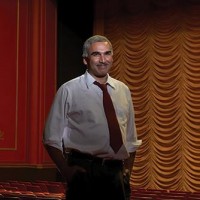
Though Prakash Younger’s interests range widely across the humanities (including English and world literature, political philosophy, geopolitical history, and art history), his work as a teacher and scholar is grounded by a long-standing engagement with the cinephilic traditions that have shaped Film Studies as a discipline. Though his work is rooted in close attention to aesthetics and the details of cinematic form, Younger’s ultimate goal as both a teacher and scholar is to show how films give us an enhanced purchase on the real world beyond them. By taking advantage of the access films provide to the experience of other times, places, cultures and sensibilities we enhance our ability to connect with the world we live in today; unlikely as it may seem, a French film from the 1930’s or a Bollywood film from the 1970’s may turn out to be the “message in a bottle” we have been waiting for, the magic lens that brings certain facts and possibilities of the present into sharp focus. Studying film is a detour that is justified by the fact that, in the end, it always gets us to the right place, faster.