Form Inversion in Alfred Hitchcock, Part 1
Hitchcock and Romantic Irony
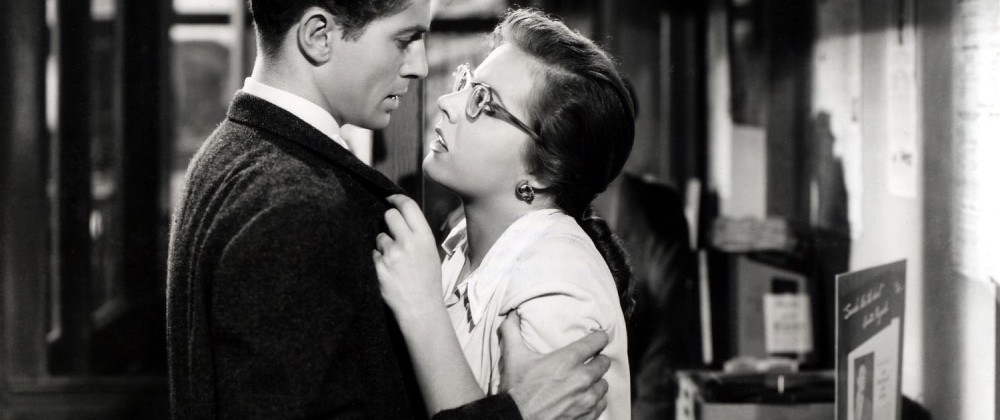
This paper originates from shorthand notes taken during a formal talk given by guest speaker Richard Allen, on March 15, 2007, at Montreal’s Concordia University. In an eloquent way, Allen was promoting his upcoming book, titled Hitchcock’s Romantic Irony: Storytelling, Sexuality and Style. [1] Subsequently, Allen’s book forms the basis for this paper, in which I demonstrate that inversion mechanisms function as important narrative plotting strategies in the corpus of Alfred Hitchcock’s work; and that such narrative pivoting devices are fundamental plotting elements which can be used to tell suspenseful stories, and that these types of narrative reversal may be useful to the structuring of other kinds of genre schema in the production of fictionalized narrative story telling.
Allen’s overall approach to studying Hitchcock begins with the recognition that there is a large amount of quality literature on the subject of his films. Many longstanding critics, such as Donald Spoto, Raymond Durgnat, Robin Wood, and Lesley Brill, as well as recent ones, such as Michael Walker and Susan Smith, have contributed to this bulk of critical literature on Alfred Hitchcock. For example, Allen recognizes the acknowledged reflexive nature of Hitchcock’s work. Indeed, Hitchcock’s practice of using the cameo appearance to create a narrative world of self-conscious artifice is well documented. [2] Another practice in reflexivity is authorial surrogacy. For instance, the character of Professor Jordan in The 39 Steps (1935) brings another major motif to Hitchcock’s work: the surrogate director. [3] Hitchcock’s films recurrently incorporate these surrogate figures, through whom he reflects on his own understanding of film authorship. But even if these motifs represent ways to address and invoke the role of the audience, Allen believes that it is not enough to explain Hitchcock’s formal method only in terms of reflexivity and authorial interpolation. Allen believes that there are other forms of evidence that exist within his films pointing to his method. We will find that this more elusive evidence supports an invisible presence that the director sustains throughout his work. The goal of this paper is to uncover the mysteries surrounding this invisible God-like presence whose hidden secrets give significance to the world that Hitchcock fabricates.
This paper hypothesizes that Hitchcock’s formal method is constituted of a distinctive worldview that reflects a uniquely chaotic universe, one based on a romantic ideal that somehow gets distorted. Accordingly, one of the goals of this paper is to uncover the relevant facts about romantic irony which, taken together, inform us about Hitchcock’s formal method. Once we arrive at recognizing the nature and character of romantic irony in Hitchcock, we can then identify its different forms. For instance, ‘ironic inversion’ can drive romantic irony in a downward spiral toward isolation, undercutting transcendence and the realization of the romantic ideal. In another instance, ‘moral inversion’ made possible by the subversion of our moral coordinates can function to create ironic ambivalence through a complex mix of suspense, mystery and surprise. While this paper will not greatly elaborate the subversion of our moral codes, it will closely examine the processes that lead to ironic inversion. In doing so, we will find that there is a locally active process that we will simply call form inversion, which works throughout the plot of a film, constructing a globally ironic view of the narrative and forming the overall impact that we attribute to ironic inversion.
The paradigm of romantic irony can be used to express two different aspects of Hitchcock’s narrative form. In a nomenclature similar to Allen, we define a vertical form that inscribes authorial self-consciousness and a horizontal form that maps narrative meaning beyond any self-reflexive explanation. [4] In short, Hitchcock’s films are made up of two narrative structures, one that is a specialized form of self-conscious narration and another that shares a particular attitude toward the romantic love story.
In the early writings of Robin Wood we have the notion of ‘The Therapeutic Hitchcock,’ an argument that Hitchcock’s films allow us to enter into the darker regions of human activities, bringing us into the taboo realms of humanity’s various perversities. But then, cathartically, they in turn allow us to come out ‘cleansed’ from these shadowy experiences of deviant or divergent social behaviors. According to Allen, the romantic ideal of the heterosexual romance is like a rope that is made up of two twisted strands. The human ideal of romance is entwined with man’s affinity for its opposite: human perversity. Allen makes a link between Hitchcock’s romantic ideal and Freud’s concept of polymorphous perversity. He states that: “In a literal sense, perversity is associated in Hitchcock’s work with the fact of human sexuality itself, considered as the uninhibited expression of impulse that is free of any moral or social restraint.” [5]
Taken to its limit, human perversity is associated with death. The death of the couple is always lurking in Hitchcock’s films, with the possibility for the annihilation of the ‘other’ and the dissolution of the ‘self.’ In many of his films, concealed within the mild mannered character of the gentleman hero is a sexual predator with a compulsion to kill women for his own sexual pleasure. An example of this behavior is seen in Suspicion (1941), where the hero, John Aysgarth (Cary Grant), seems to be trying to kill his wife, Lina MacLaidlaw (Joan Fontaine). The other side of this argument has to do with the heroine. Under the ostensible portrayal of her virginal character lies a sexually promiscuous woman. An example of the implicit prostitute is seen in the romantic thriller To Catch a Thief (1951), where the blonde heroine, Francie Stevens (Grace Kelly), seems determined to seduce the hero, John Robie (Cary Grant), with her open sexual behavior. According to Allen, the narrative logic that brings love/life and perversity/death together in Hitchcock’s works is the ‘both/and’ logic of romantic irony: “In general, Hitchcock, the narrator, self-consciously draws attention to the force of perversity by suggesting rather than by showing it. Hitchcock is an aesthete in the very precise sense that the extraordinary formal realization of his works functions as a displaced expression of human sexuality.” [6]
An examination of Hitchcock’s films reveals that sexuality carries with it not only the stench but also the stain of human perversity. His aestheticism works through three possible formulations of the romantic ideal: 1) An ambiguously connoted romance that achieves an idyllic transcendence to a state of love, 2) An idealization that contains something destructive, or 3) An idealization that leads to annihilation and death. These three possibilities can give us a glimpse into Hitchcock’s religious views on heaven, limbo, and hell, since the romantic ideal manifests the possibilities of rebirth (heaven), suspended animation (limbo/purgatory), and condemnation (hell). We can combine these forms of the romantic ideal into a unified nomenclature (as does Allen). Firstly, there are films about romantic renewal. In these comic thrillers, Hitchcock acts as a divine narrator controlling his characters from a position above the fictive world. In films like To Catch a Thief and North by Northwest he directs elements of good fortune onto his protagonists while making sure that the elements of human perversity are used to good ends toward romantic renewal. Secondly, there are films about ironic ambivalence. The majority of his works lie within this category. British films with an ambivalent tone are The Lodger (1926) and Murder! (1930). Hollywood films with ironic ambivalence are Strangers on a Train (1951) and Rear Window (1954). In these works, Hitchcock acts as a more reserved narrator who suspends himself from making any commentary, hovering in between the romantic ideal and its subversion. In this case, the simultaneously opposite perspectives compete in a back-and-forth struggle for dominance while the narration refrains from judgment. These competing perspectives are sustained by making use of the distinctions between the point-of-views of the characters and the narration. Thirdly, there are films about ironic inversion, which mostly interest us in this paper. Only a few of his works lie within this category, containing narratives that destroy the romantic ideal all together. Examples of such films begin with Downhill (1927), a silent British film that becomes a research platform for Hitchcock.
The basic thrust of Downhill is the feeling of descent and instability both of which are expressed by an anxious uncertainty that a situation of confidence and normalcy can be destroyed by an error or a trick in fortune. Even its title ‘downhill’ is revealing, as it anticipates the much later film Vertigo. It also tells us about the downward turn and continuous descent into misfortune of its hero. Despite a swift and happy ending, Downhill is one of the darkest and most pessimistic of Hitchcock’s early films. It is his most persistently misogynist work, with a succession of predatory and manipulative female characters who combine to torment our hapless young hero, Roddy, played by Ivor Novello. Downhill is like the downside of the performance of Novello in The Lodger, allowing his dramatic character to play out to its full rebellious nature against the family and institutions, and giving him the freedom to express fear and distrust, even hatred, of women. Other films that completely undermine the romantic ideal are Vertigo (1958) and Psycho (1960), both of which exhibit characteristics of play acting or masquerading that are often taken to the point of death. In these films, Hitchcock acts as a demon-like narrator who deceives the spectator.
According to the writer Lesley Brill, Hitchcock presents himself as a true romance director, one who uses a distinctive filmmaking approach that celebrates the formation of the romantic couple in the face of annihilation. Brill states that: “More important than any single formal characteristic of Hitchcock’s movies is the flexible structure of a romancer’s conception of his art and of human life … the romantic complications and solutions on which it North by Northwest is based underlie most of his other films. Even his ironic movies are best understood as parodies or inversions of the romantic formula.” [7] Brill’s statement makes an explicit connection between Hitchcock’s ironic films and the inversions of the traditional romantic model. This linkage is important to our understanding Hitchcock’s use of romantic irony in the form of ironic inversion in the global development of his narrative corpus. In another section of his book, titled The Hitchcock Romance, Brill states that: “Both [Vertigo and Psycho] are intensely ironic movies, with the attendant reversals, frustrations, and inversions of romantic motifs and ideas[my emphasis].” [8] Brill’s statement is important because it makes an explicit connection between Hitchcock’s ironic movies and the inversions of romantic motifs.
Hitchcock’s inversion aesthetics can be understood from two different perspectives. First, Hitchcock reverses the romantic ideal to the point of creating a sensibility akin to fairy tales or mythic stories. Second, he simultaneously perverts the idea of romance in order to reveal its darker underside. Although Hitchcock seems to be schizophrenically split within his totalizing ways of seeing, these two apparently diverging perspectives function in complementary fashion and form the basis for romantic irony’s logic, which is a form of anti-logical reasoning. Thus, the logic of romantic irony is anti-logical with respect to the Socratic perspective. In Socratic irony one can say something about a subject through the assertion of its opposite. In romantic irony, stating an opposite does not function to assert any truth, instead it functions to create ambiguity through simultaneous assertion of incompatible propositions. For example, romantic irony has been used to secularize the concept of redemption within the idea of nature, as opposed to that of the divine. Thus, in late romanticism, we have the secularization of the concept of romance, in which the ideals of divine redemption come face-to-face with nature’s annihilating forces, at least from the perspective of existential nihilism. In human beings, there is a spiritual quest to regain a state of pure innocence that has been lost due to some contact with the impurity of the natural environment. This is akin to the desire of regaining one’s health after being exposed to some corrupting disease. For Hitchcock, it is the ideal state of romantic love that is lost when it comes into contact with the ironic perversities of human beings. It is the assertion of simultaneously incompatible propositions that facilitates romantic ideals mingling with the ironies of everyday life. Thus, there’s a substantive dimension of romantic irony that gets built into a Hitchcock film. Lesley Brill puts it this way: “Loss and recovery and quests for innocence organize the plots of almost all his movies. In the majority of Hitchcock’s works, the conventions of happy fairy tales, displaced into cinematic forms, lead to conclusions in which central lovers live more or less happily ever after. In the ironic movies, romantic expectations are raised only to be disappointed“ [my emphasis]. [9] Brill is clear about how romantic irony gets built into the films of Alfred Hitchcock. His previous statement about the inversion of the romantic formula [my emphasis] helps us understand how Hitchcock works at the strategic level to develop his narratives and realize his worldview. His last statement about romantic expectations being disappointed implies that Hitchcock uses romantic irony, specifically ironic inversion, to undermine the romantic ideal in its totality.
The remainder of the first part of this paper will be confined to a discussion of films that take the form of ironic inversion. The best Hitchcockean example of an ironic inversion is Vertigo. It’s antithesis is North by Northwest, which is a narrative of romantic renewal. The plot of Vertigo is a complex narrative construction that points forward in time to the equally contrived plot of North by Northwest, which conspires to protect the hero from the possibly harmful ironies of everyday life and brings about the realization of the romantic ideal at its ending. But this is not the case with the former film which undercuts Scottie’s fantasy and brings death to his ideal woman. The powerful impact of the ironic inversion is best seen on a global level of narrative development when we compare the endings of these two films. The sensibility of romantic irony in the form of a romantic renewal is exemplified in the cut on action that bring North by Northwest to a climax. In a sublime match on action, Hitchcock cuts from Roger Thornhill holding onto the wrist of Eve Kendall dangling over the edge of the cliff on the side of Mount Rushmore, to a shot of Roger pulling Eve up to a warm bed on a transcontinental express train. The match on action is a perfect example of how ironic juxtaposition causes romantic transcendence, in which it immediately dramatizes and overcomes the contrast between the real danger and the ideal outcome, that is, romantic renewal. It is the transition –where the second scene is negated by the first– that creates the formal ironic reversal. It is a form inversion associated with transcendence and romantic renewal. The black figure of the nun at the end of Vertigo is an inversion of its angelic form and it is her apparition that causes Scottie to lose hold of his beloved Judy/Madeleine and to frighten her into falling to her death, all of which is an inversion of the ending of North by Northwest.
Vertigo works in an opposite way to North by Northwest, even though both films can be viewed as being romantic. Indeed, Vertigo is a deleteriously romantic film but without a comical tone. According to information given to us by Allen in his talk, one of the co-writers of Vertigo, Samuel A. Taylor, said that the character of Marjorie ‘Midge’ Wood (played by Barbara Bel Geddes) was included to render a sense of normality, which would in turn give a certain amount of credibility to the character of John ‘Scottie’ Ferguson (played by Jimmy Stewart). This kind of embedment allows Hitchcock to produce romantic irony at a local level of the plot in the form of an inversion of a romantic motif, as Lesley Brill points out in his book. It is a formal inversion mechanism that falls under the general category of a form inversion. In our case, it contributes to the formation of ironic inversion at the global level of narrative development. This is especially true for the scene where Midge has painted herself into the figure of Carlotta Valdes. With the painting as the romantic motif, [10] we have an interesting double form inversion, the inversion of the image in the painted portrait of Dorian Grey, and the inversion of the image in another painting that is seen in one of Hitchcock’s early movies, Blackmail (1929). In Blackmail a painting of a clown is used ingeniously to end the film. The clown painting symbolizes Alice’s lingering feelings of guilt and belongs to the category of Hitchcock’s buffoonery devices. In Vertigo the painted portrait of Midge as Carlotta Valdes punctures Scottie’s romantic illusion, as the painting is a sign of the femininity (maybe even the femme fatale kind) which resides in the ghost-like image of Carlotta Valdes. What all this means is that the romantic ideal sought by Scottie is an obsessive love that can only be realizable in death.
Alfred Hitchcock’s Vertigo is a film with two forms of aestheticism. At the beginning of the film a masculine aesthetics dominates, but as the movie progresses a feminine aesthetics takes over. In the first half of the film a masculine aesthetics functions primarily through Scottie’s point-of-view shots. Scottie is hired by an old acquaintance, Gavin Elster (played by Tom Helmore), to follow his wife who seems possessed by a dead relative, Carlotta Valdes. But Scottie is tricked by a masquerade in which Judie Barton (played by Kim Novak) poses as Ester’s wife, Madeleine (also played by Kim Novak). The plan is to trap Scottie into witnessing Madeleine’s apparent suicide from a bell tower, after she goes mad from this seemingly demonic possession. The plan is ingenious because Galvin knows that acrophobia will prevent Scottie from climbing to the top of the bell tower where the suicide is supposed to take place. In fact, Madeleine Elster is already dead and it is her corpse that falls from the tower. But there is a twist in the plot because Scottie Ferguson’s mission moves from following Galvin’s wife to rescuing Madeleine from herself. This pseudo-inversion goes further because there is an ostensible romance that develops between the ‘second’ Madeleine and Scottie. The result is that Scottie is so emotionally distraught after Madeleine’s death that he needs medical treatment.
In the second half of the film, Scottie leaves the hospital a reduced figure. In his diminished capacity, Scottie encounters the person of Judy Barton, a woman who looks like Madeleine. He begins to pursue her romantically but there is another twist in the plot. He is also obsessively trying to re-create her into the ideal image of Madeleine. It is the sublime beauty that Scottie sees in the image of his ideal, which transforms (inverts) the film’s aesthetics from masculine to feminine. Hitchcock’s inversion aesthetics is another kind of form inversion that enters into the ironic inversion of this film.
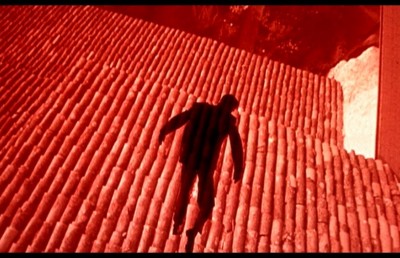
The full impact of the ironic inversion comes at a specific moment in the climactic scene, just before Judy Barton, playing Madeleine Elster for the second time, falls off the top of the bell tower at the Spanish mission. The moment of the staging of the kiss seems to be a last chance for Scottie to finally get the ‘ideal girl’ of his dreams. But just as they embrace, a black figure moves up to the top of the stairs and enters the bell tower. This horrible apparition causes Judy to suddenly turn away from Scottie. It is as though she has just seen a ghost, the specter of the real Madeleine Elster. It shocks her into taking a step backward onto the ledge of the tower, where she trips and falls to her death. This deadly event leaves Scottie devastated. At the ending of the film, we see him standing on the ledge, right up to its edge, slightly leaning forward, and looking partly downward. He seems frozen in place and isolated in time. He is like a man who has been flipped inside out –inverted. Lesley Brill explains the ending of Vertigo this way: “For a moment, love seems to have conquered all knowledge and all resentment. There can be ‘no bringing her back’ (she has committed murder), and still Scottie embraces Judy. In doing so, he implicitly accepts both her love and his own for her (but only for a moment). Even if Scottie and Judy briefly transcend themselves, the artistic logic of the film is too powerful for them. A specter rises out of the shadows, Judy shrinks back, and we hear her scream as she falls to her death. The pull of the downward has again triumphed. Freedom, safety, and love prove fleeting or illusory. In the vengeful, entropic fictional universe of Vertigo, no mistake goes unpunished. What goes up must come down, what is gained cannot be held (for long).” [11] We can truly say that the re-creation of the illusion is what shatters the illusion. In the end, Scottie is left with nothing because he has not only lost Judy/Madeleine but also his memory of Madeleine, his romantic ideal from the past. The ironic inversion is complete because he is left in total isolation, a man frozen in time with no past, no future.
In reading Vertigo, we can see that the black figure of the nun is the augmented image of nothingness. It is a seemingly demonic image that ordinarily should be angelic. It is the opposite of the diminished image of Scottie Ferguson before he slips into nothingness. After Scottie comes out of the hospital he is a human soul that needs saving. But there is another form inversion at play, one that adds again to the overall impact of the ironic inversion. It comes in the form of a visual pun in which the nun is mistaken for a ghostly figure of death, the apparition of the dead body of Madeleine Elster. Initially, the figure of the nun is a deus ex machina, an unexpected event saving a seemingly hopeless situation. However, the form inversion undercuts the possibility of transcendence and the realization of the romantic ideal. The Catholic nun, who is normally the servant of God, is now inverted to be a demonic agent of death. It is this form inversion that, in an implicitly cinematic way, causes Scottie to lose his beloved Judy/Madeleine and send her to her death. There’s no greater horror in a Hitchcock film than the failure to properly use the human instincts of love and redemption, on which the recuperation of innocence depends.
Theologically, the apotheosis of the human impulse of redemption manifests itself in Christ. Lesley Brill explains it this way: “We have seen that Hitchcock in more romantic films displaces and eroticizes Christian doctrine by associating it with the redemption and rebirth that his heroines and heroes achieve through their love and faith in each other. In Vertigo, Christian symbolism, like other romantic motifs, is inverted [my emphasis]. It is diminished to one more ironic sign of the irremediable human condition.” [12] It is important to notice that Brill’s statement about religious symbolism in Hitchcock’s movies is a pointer to his own religious views. Throughout Vertigo, inverted Christian symbolism is associated with Scottie’s emotional state of mind, which manifests mostly anguish and frustration. We see him suffer for the sins of others but unlike Christ’s power to redeem our sins, we see him agonize in vain. Hitchcock’s religious views are particularly ironic because he places the horrible deaths of Madeleine and Judy in the mission of San Juan Bautista, which represents the symbol for John the Baptist, the messenger of renewal in Christ. Not only does this religious setting mock the anti-redemptive outcomes of their visits there, but also inverts the symbol of the messenger’s power to heal. Moreover, the Holy Cross represents Christ’s crucifixion and his death, followed three days later by Christ’s resurrection and his return to life, a powerful symbol for the heavenly possibility to redeem ourselves from our earthly sins and achieve a spiritual ideal. But in Hitchcock’s Vertigo, this possibility is totally frustrated because Christian symbolism, like other romantic motifs, is inverted. There is no mercy in this film because the Holy Spirit’s blessings of the divine grace cannot take hold. Brill puts it in these words: “The quality of mercy, indeed, hardly ever appears in Vertigo. The nun’s words, and the Christian imagery that Scottie’s pose in the last shot culminates, only confirm the crushing absence of grace. The emptiness at the center of life that inversions of Christian imagery is reiterated by artifice and such related motifs as reflections and dreams.” [13] Hitchcock’s Vertigo is like the portrait of a person taken in silhouette: it withholds as much as it shows. The other side is concealed by the profile that we do not see. Mirrors and the reflections that they produce represent the existence of the other side, as does the form inversions that build up into the overall force of the film’s ironic inversion. Physics show that a reflection is the result of an optical inversion of the light hitting and bouncing off the surface of a non-absorbing material. Cine-physics, if such a term applies, show that certain form inversion mechanisms, such as pattern reversals, frustrated expectations, and motif inversions, drive Vertigo into a cinematically romantic state of ironic inversion. However, the reader should be aware that other approaches to Hitchcock exist. For example, Sigmund Freud’s psychoanalysis as another approach to explain the intricacies of Hitchcock’s work. [14]
Whatever approach we take to reading the ending of this film, we have moved, in an arbitrary moment, from the possibility of regaining the lost romance to total annihilation: the nihilistic isolation of Scottie and the death of Judy. On this basis, we can see that we are dealing with a process of focalization that is produced by the interplay of multiple and simultaneous co-existing perspectives. Accordingly, we may ask ourselves two different questions. Does Judy fall to her death on the basis of fate? Or does she throw herself into the abyss? Whatever the response, the outcome is the same: death. Truly, there is an anti-Aristolean logic at play in Vertigo, which is the ‘both/and’ logic of romantic irony. The ironic inversion of Scottie’s romantic ideal certainly supports this conclusion.
Alfred Hitchcock is an auteur linked to films in the suspense thriller category, yet Hitchcock cannot be pinned down into this single slot. At least on one level, Hitchcock’s cinematographic representation of the suspense thriller is focalized through the predatory male aggressor prototype, which in many cases does not contain the prototypical happy ending. [15] As we have seen in Part 1, romantic irony is an active germinal principle in Alfred Hitchcock’s work; and in Vertigo, Hitchcock uses romantic irony in conjunction with ‘suspense.’ Moreover, we can be more specific about this general conception, as there are at least two aspects: first, it is ‘suspense’ as a distinctive output that comes to the foreground of Alfred Hitchcock’s work. So we may ask: “What characteristics make Hitchcock’s concept of suspense so distinctive?” And second, this distinctiveness of suspense comes into Hitch’s work in the form of style or aspects of style with a certain kind of aestheticism. Hitchcock’s aestheticism can be seen in the manner in which he displaces apparently immovable aspects of human activity, especially those actions that concern human motivations. So again we may ask another hard question: “How does Hitchcock come to represent, express or formalize those things about human activity and motivation which are indescribable, and in turn, indefinable, un-namable, and thus, un-represent-able?” The answer is that somehow Hitchcock finds representation through ‘human means.’
Therefore, ‘suspense’ and ‘aestheticism’ are interrelated conceptually, as well as formally, in Hitchcock’s work. Moreover, we may say that Alfred Hitchcock is an epicurean and aesthete of suspense, as he begins to pursue suspense for its own sake, as compared to its normally traditional classical sense. As the film critic Noel Carroll explains, classical suspense, of the type found in David W. Griffith’s early narrative cinema, plays out the basic grammar of suspense narration; that is, classical suspense involves the interplay of two incompatibly opposite outcomes, in which there’s a greater likeliness for the undesirable outcome to happen, and less of a likeliness for the desirable outcome to be realized. An obvious example of classical suspense is the scenario of a woman/wife living in a domestic space under extreme peril, while concurrently the man/husband is away from the home and is alerted to the peril. The audience wonders: “Will he get back on time before she is attacked or harmed?” As time wears on it becomes more and more unlikely that the man/hero will arrive; however, in the end, the ‘saving hand’ of the hero will arrive just in time to stop the assailant and ‘save’ the day. As far as Hitchcock’s work is concerned, classical suspense is not important, though it certainly contains some of it; what gives the so-called distinctiveness to Hitchcock’s suspense is the way that it hooks up with conventional morality, and more particularly, into the morality of melodrama in the broader sense. Richard Allen talks about a form of suspense that he vaguely calls ‘Manichean’ or ‘manichean paranoia,’ that is, manichean suspense. Think of ‘split personality’ (good versus evil) as a point of reference.
The structure of suspense narration is based on a moral construction: good versus evil. If the suspense is siding with the ‘good’ then the ‘good’ = woman/girl => she gets saved, which is a ‘good’ outcome; however, if the suspense is siding with the ‘bad’ then the ‘bad’ = man/ villain => she gets killed, which is a ‘bad’ outcome. Here’s the question: “How can D. W. Griffith’s Birth of a Nation (1915) be seen as a moral photoplay?” Even in this morally or ethically controversial film, one must remember that it is the audience’s expectation –that the white hooded clansmen will come to save the day– which is moral in the construction of this questionable film; even if it is incompatible with our own contemporary moral values. It is the desirable that is characteristically unlikely, while the undesirable that is likely to happen. D. W. Griffith made films that contained ‘objective’ suspense (in the form of classical suspense), Hitchcock’s suspenseful films supports ‘subjective’ suspense, in which he filters the force of suspense through the characters’ point-of-views (POVs). Hitchcock restricts his narration in such a way that he restricts narrative POV to that of the characters.
It is this ‘subjective suspense’ in Hitchcock that creates the distinctiveness of suspense found in his films (as opposed to classical suspense). The distinction is encapsulated in the famous Hitchcockian anecdote about a “bomb that has been planted under a table without the characters being aware of it.” Firstly, we have the overall image of people sitting at a table where a bomb has been planted and suddenly it goes off => SURPRISE (neither we nor the characters knew about it). Secondly, let’s say that we have the same situation but this time the audience knows that the bomb is there, under the table, ready to go off at any time => SUSPENSE (we know something that the characters do not know). This latter form of suspense is called ‘vicarious suspense’ (i.e. vicarious = experience in one’s own imagination after watching or reading about another’s person’s actions or feelings: eg. the vicarious thrill of watching other children being bad). With ‘vicarious suspense,’ we worry on behalf of our characters; and like classical suspense, we’ve been given knowledge, which the characters do not possess (omniscient suspense).
Whereas Griffithean suspense is a form of classical suspense where the omniscient narrator (here, the director) knows more than his characters, it is by definition ‘vicarious suspense.’ Vicarious suspense captures the dramatic play between time, character, and knowledge, with the amount of knowledge that a character gains over time being either sufficient or insufficient to resolve the outcome of an event or situation. However, there is at least one other form of suspense: when the narration is suppressed with regards to the spread of knowledge among its characters and audience.
Isn’t suspense a form of withholding information, and thus, creating anxiety in the audience to an unknown outcome? The answer to the query according to Hitchcock is No! While ‘vicarious suspense’ is about knowing what the character doesn’t know, the case of ‘suppressive suspense’ is about withholding data or information that involves the spectator with an emotional investment in the need to know; and the audience relationship that develops with the story is such that it does not have to evolve with the filmic processes of character identification since it could be realized through the use of camera techniques.
For instance, ‘vicarious suspense’ is a form of high suspense and it could be likened to approaching a child with a spoon, and then at a certain distance from the child, withholding it; other examples from the early days would be Serial Queen melodramas (produced between 1912 -1925) and the famous ride to the rescue. For the case of ‘mystery suspense,’ it is a lower form of suspense because it carries with it a more pervasive mood, which is an idea of a suspense that plays an equally important role in Hitchcock’s work.
Moreover, while historically ‘objective suspense’ is what is called ‘classical suspense,’ ‘mystery suspense’ is a form of suspense that is characteristic of horror and mystery films, as these movies play on the idea of suspense in terms of point-of-view (POV). Thus, suspense is playing with the POV of the subject-character or object-camera. It turns out that Hitchcock is trying to explore all these ideas of suspense, which can be seen in The Birds (1963). For an example we can look at the ‘Jungle Jim’ sequence, in which Hitchcock underscores a particular sense of temporality for the unfolding of the scene, the passing of time giving us a sense of the birds gathering, almost as if there was a deadline at play. Hitchcock cuts only when he has accumulated enough time in waiting. Hence calculated timelines are developed in this sequence. It is not simply a matter of diegetic time. There is no subversion of reality here. In another sense, we are rooting for Melanie, as we see her alone –iconographically like a lone bird. A suppressive narration is employed when Melanie looks up at the birds and we get her restricted POV. She sees the birds and is at first ‘surprised’ (this forms ‘suppressive suspense.’) Moreover, at some point Melanie and the spectator both realize what is happening, but the children and teacher in the nearby school do not know anything about the gathering of the birds; hence there is another form of suspense going on here (‘vicarious suspense’). At first the audience has knowledge Melanie does not (that many birds are gathering behind her). Which makes her like a ‘fish out of the water’ in a primal landscape. We are also informed of a hierarchy within the birds represented by the crows on the upper echelon and the seagulls on the lower echelon of the ‘Jungle Jim’ set, which shows us a social organization and intelligence at work.
Hitchcock shows us a reaction shot by cutting from Melanie’s restricted POV to a shot of her. This restricts our knowledge of the birds to Melanie’s POV, as we have a shared ‘suspenseful mystery’ with this developing situation. Thus, when she sees the birds, she’s surprised, as ‘surprise’ and ‘suppressive narration’ are not incompatible processes, whereas ‘surprise’ and ‘classical suspense’ are incompatible elements of narration. There are mini narratives developing here, as we can notice ‘vicarious suspense,’ ‘restricted POV narration,’ ‘suspenseful mystery,’ and ‘shared suspense.’ There is vicarious anxiety associated with the spectator relative to that of the children’s experience.
We can now return to the initial question: “What characteristics make the suspense distinctive in the films of Hitchcock?” In the so-called ‘Hitchcockian Universe’ a different sense is given to the meaning of classical suspense since Hitchcock subverts the normal coordinates to classically omniscient suspense, doing so by drawing a wedge between the spectator’s sense of morality and his/her expected response. Following this reasoning, a group of other questions arises: 1) What sensible expectations might come to mind when spectators experience such suspenseful spectacles? 2) Is there a sense of moral disdain at seeing the possibility of success for the evil doer, or does the spectator root for the devil or rogue element in such cases? 3) In other circumstances, do spectators root for the figure of the dandy or the woman who is showing off her femininity? 4) Do spectators watching such suspenseful films have sympathy for devilish characters or do they simply look up to the villain’s special qualities (his/her wit, flair, and sense of style)?
Very often our ideas of morality are contrasted with our sense of expectation; take for examples, Strangers on a Train and Psycho (1960), in which we have sympathetic anxieties for the evil character. For instance, we see Norman Bates cleaning up Marian Crane’s room and then disposing of her car in the swamp behind the motel. As Bates watches the car slowly sink into the quicksand, and then suddenly stopping, we experience an intensely vicarious form of suspense; we are rooting for the car to finish its descent; in effect, we are rooting for the killer-villain. Hitchcock manipulates us with narrative POV, in this case doing so by focalizing on the developing narrative through Norman Bates’ POV. In Francois Truffaut’s interview book Hitchcock/Truffaut Truffaut brings this same point out quite concisely, doing so by foregrounding clearly Hitchcock’s manipulation of point-of-view and moral sympathy (references occur on pages 73, 109, and 272).
“Character identification has nothing to do with it.” (Alfred Hitchcock)
In the case of the classic suspense scenario, in which a person, more often a female, is threatened by an intruder, Hitchcock uses the mechanisms of narrative suspense to trump the spectator’s moral judgment/response, and in so doing the director creates a cyclic ‘back-and-forth’ movement between extreme POVs within the moral arena. This process includes the formation of a ‘mental duality’ within the spectator, a bijective state of mind whose psycho-dynamics resemble the continuous double process of enfoldment and unfoldment, and whose action, to some degree, impacts the subconscious with a gap of indecisiveness, one which needs to be filled with some form of medicinal moral/immoral ingredient, but never is. Once this receptive opening has been created by the forceful ‘double action’ of the Hitchcockean suspense, a sort of twofold response potential enters into the sensibilities/expectations of the individual, that is, a simultaneous duality of oppositely driven, contradictory responses begin to circulate inside his or her mind, where internal behavior patterns are born. So, in this fashion, we, the spectators, want the intruder to enter and violate the helpless solitary person and yet, at the same time, we are rooting for that person to evade the possible assault all together. Classically, such a dual response scenario is contradictory, yet it is also so very much fitting to the evolutionary development of modern suspense.
The capacity of the cinema to position the spectator in relation to what the character is doing, either protagonist or antagonist, involves an epistemic alignment that is irrespective of the human traits under question. The processes that lead to suspense are the results of hardwired responses built into human beings because the mechanics of suspense is to trump our morality through a character who may be good or bad. This is truly the articulation of romantic irony. On one hand, it aligns itself with the side of the moral, while at the same time the director uses suspense in the opposite direction. For example, in Strangers on a Train Bruno drops the cigarette lighter down the sewer drain, and the audience is placed in a duality of contradictory or contrary positions: on the one hand we want the bad guy to fail, but the bad guy also elicits an uncanny sympathy that involves us wanting him to succeed in retrieving the lighter from that drain.
To return to the example of Birth of a Nation (1915), a contemporary spectator will not feel the same kind of suspense as spectators of yesteryears, that is, they will not be rooting for the KKK clansmen, since there is a built-in response of resistance within the spectator developed during the intermediary years due to the changes in moral and ethical values. In the tennis match in Strangers on a Train Guy is playing hard to win in order to foil Bruno’s plan of using the lighter to incriminate Guy for the murder of Guy’s wife. Moreover, Guy could just as easily throw the tennis match, but the police are watching, and so the situation is manufactured for the purposes of suspense.
There is an underlying Nietszchean subtext to the homoerotism, which permeates the textural thematics of Strangers on a Train. Such an important philosophical treatment needs special attention when carried into film and Hitchcock heeds its impact on the plot by embedding it into a narrative underground, where sub-textural undercurrents whirl about as sub-narrative deviations or eddies along side of the overall flow of the main narrative thrust. Foremost in Hitchcock’s scheme is one of Friedrich Nietszche’s foundational elements to his re-evaluation of metaphysics, the ”Will to Power.” Hitchcock grants it prime real-estate in his story by inverting it as the “Power of Will,” a major subtext that motivates the characterization of his two protagonists, Bruno and Guy, all of which is most important in the development of suspense in this cinematic complex. More to the point, it is the ‘doubling effect’ that occurs between these two characters, which is of prime importance to understanding the true nature of this narrative construct. For instance, there exists in both characters a human drive that can be denoted as an ‘insistence to win.’ Such a subjective motif helps create narrative flows of suspense that move back and forth within the sequence of shots that are associated with particular scenes, all of which can be said to form a parallel structure. There is a ‘dog fight’ between the two tennis players, just as there is a ‘dog fight’ between Bruno and Guy. Even the music that accompanies the lighter retrieval scene reinforces our desire for Bruno’s success. It starts off in slow tempo, increasing its rhythm with time accordingly, with a large jump in rhythm right after Bruno drops the lighter for the second time, and then climaxes in a sense of finality when he retrieves the lighter, at which point we are struck by a great sense of relief. A similar moral inversion occurs in Hitchcock’s 1972 Frenzy, in the potato truck scene, where the spectator feels a sense of relief when Bob Rusk finally succeeds in pulling apart Barbara’s clenched fist to retrieve his incriminating tiepin. It is the emotional energy that Rusk expends, which heightens our level of sympathy toward him. In both these examples –Rusk’s retrieval of the tiepin and Bruno’s retrieval of his lighter– there is a moral inversion in the suspense.
The inversion of suspense is a tool Hitchcock uses to undermine morality, like with his preciously sophisticated black comedy. Both romantic irony and black comedy are ways to embrace the ‘perverse,’ as they forego the lure of perversity in the ways that they subvert our normal sense of moral alignment.
The lighter/tennis match scene involves a nesting of mise-en-scène and camera techniques (Hitchcockian aestheticism). All of the alternating shots between Guy/tennis match, Bruno/lighter retrieval create a form of infinite regression, a mise-en-abyme of a ‘doubling parallelism’ that evolves to a point of climax when Bruno finally lifts the lighter out of the drain; as noted, even the soundtrack participates in this nesting, as we can discern the diegetic sounds of Guy’s tennis racket hitting the ball (pluck, pluck, pluck) as the parallel editing proceeds to alternate the shots of Bruno and Guy; and in a sub-alternating fashion there is another common source of our ‘rooting function,’ one that involves like sympathies: 1) both of them not getting caught (since both are involved in the commission of this murder) and 2) the perusal of their implicit homosexual relationship (at least at the implicit level, their struggle amounts to a petty squabble between homosexual lovers). With regards the latter, there is the frenzied, climactic ending, with the phallic up and down pounding of the merry-go-round horses. The emerging pattern is a parallel type of derailment, which is at work here –something that goes off course, like the derailment of a train– and in the suspense that is associated with our identification with the character of Bruno. The romantic or homoerotic love between Bruno and Guy gets derailed in a similar way as does the rest of the more important elemental motifs associated with their homosexual affair. It is through the use of rapid editing techniques, Einsteinian montage, and the built-in phallic imagery that allows a particular kind of aestheticism to emerge out of the ‘narrative romantic irony.’ Moreover in Strangers on a Train, the suspense does not quite work once the so-called ‘gay split’ happens because the audience’s allegiances are no longer comfortably aligned in the narrative, as even the untutored spectator is drawn out of the filmic suspension of disbelief to which he had been absorbed before the ‘gay split.’ In a strange way, it is Hitchcock’s aesthetization that threatens to reduce the suspenseful force of the narrative. In one case, we resist the possibility that Bruno is going to get the lighter, while in another case we are ‘rooting’ for Guy to win the tennis match.
This ‘gay split’ may appear to suspend our sympathies toward Bruno, but this does not mean that we want Guy, the ‘double,’ to get away with this murderous crime. Thus, there are at least two different levels to the suspenseful linking of a spectator’s character identification in a Hitchcock film. The first form of character identification stems from the classical form of identification, one that links ‘identification’ to our moral alignment (we want the ‘better’ person to come out on top).The second form of character identification has to do with empathy: being in someone else’s skin (regardless of moral rectitude). Moreover, if one wishes to combine the first and second forms of character identification, then emotions of ‘empathy’ –understanding and sharing the feelings of another– as opposed to that of ‘sympathy’ –feeling sorry for someone– can be structured in such a way that we simply assume their POV. For instance, in order for us to experience a character’s sense of fear, we must identify emphatically with them. In a converse manner, the fused combination of the first and second forms of character identification can be alternatively separated because of the inherent plasticity of the thematic motifs, regardless of their romantic or ironic orientations; so in these terms, we can always have character identification happen through the emotions associated with ‘sympathy,’ as in the opening shot of Brian De Palma’s Blow Out (1981), a reworking of Michelangelo Antonioni’s Blowup (1966). [16] In the former film, we are placed in the POV of a character we know anything about, just as though we have been transformed into either a voyeur or a stalker. Cinema often elicits character identification from the audience in this way. De Palma’s most important contributions to contemporary cinema lie in his inventive and visually dynamic style. He frequently employs such techniques as the stalking, searching camera, the “God’s eye” point of view, and the expressively detailed mise-en-scéne. A master of rhythmic editing, he often opens his films with an extended, viscerally composed sequence. Moreover, Italian director Dario Argento, a filmmaker who springs out from the second generation of directors in the Hitchcockian tradition, does indeed manipulate POV to the point of being uninterested in moral issues. But unlike Dario Argento, Alfred Hitchcock is a moral director, just as David W. Griffith is, in whose work we can see, without question, the presence of a morally conservative director behind the camera and yet, even then, Griffith is relishing in his use of suspense, as we can observe that there is a growing desire in the spectator to see the villain win. In comparison, the case of Alfred Hitchcock’s form of suspense brings into debate a question concerning the place of comedy within the development of suspense: “Does comedy, especially black comedy, contribute to or impede suspense?”
If we compare the categories of suspense mystery and classical suspense, we can see that Hitchcock’s early film The Lodger (1926) is in line with classical suspense, with that particular reflexive comedic component attached to it. We can observe that in this film there is a decoupling of moral fortitude to our sense of suspense, and we lose a certain amount of the force of suspense through a process that can only be called a Hitchcockian tease. The way that Hitchcock conditions his audience in matters of suspense often recalls Freud’s jokes and their relation to the unconscious. Freud shows us through his understanding of therapeutic humor that telling a tendentious joke, one that has a point in mind, particularly of a sexual nature, may require a particular mood for the recipient of the joke.. Such a mood may be reached by engaging the patient, in our case the spectator, in lesser forms of humor such as puns and non-tendentious joking. Similarly, when someone like Hitchcock had a metaphysical point in mind, he instinctively knew that his audience had to be conditioned in a certain way. This is where we see Hitchcock use various levels or degrees of teasing within his particular forms of suspense, on which he might explore a particular image, motif, or theme.
By contrast, in Rebecca (1940) and Vertigo the darkish impulses are treated with utmost seriousness. The forbidden objects of the unconscious are treated without any ludicrous or comic undertones. Vertigo portrays Judy as a figure of sublime and perfect beauty. But when the most beautiful illusion of Judy as Madeleine is broken, the other aesthetic coloration in Hitchcock’s artistic palette takes over, with the masculine aesthetic overriding the feminine. The cinematically widespread use of form inversion in Hitchcock carries with it reversals in the aesthetics and/or moods of his films. Moreover, such ‘turnarounds’ are especially effective in helping to create labyrinthine forms of suspense, whose effects on narrative plotting make the continued developmental character re-alignment very exciting for the audience, all of which is deeply embedded in Rebecca, a movie masterpiece that has the distinction of being the original source to the Hitchcockian feminine aesthetics (as well as being a foundational element for a narrative of ambiguity). The character played by Joan Fontaine, the second Mrs. De Winter, a young woman who is never named, is desperate in her desires to become as perfect and ideally wonderful as Rebecca, the first wife. But it is Hitchcock’s artistic free-play with its perverted sense of narrative deviation, which seems to spoil the apparent neatness to this formatively normal love story, this is especially true when Hitchcock begins to focus on the lesbian desires of the house keeper, Mrs. Danvers (played by Judith Anderson), as this ‘emotional penchant’ is made to contrast with the way that Rebecca’s presence (or non-presence) is enacted or reified through the sublimity of the house as a temple of sanctity. Such ambiguous narrative constructions incorporate complexities of suspenseful events that blend into certain kinds of complicit, merry-go-round atmosphere of determinate life or death (for example in Rebecca, the grand jury’s inquest into Rebecca’s death) where the characters’ powerful homoerotic desires, including their willful ambitions toward social climbing, underline their breakaway spirits from established mores, all of which thematizes the dramatic underbellies of some of Hitchcock’s films with their “Will to Power,” Rebecca being the apogamic apex to this form of ambiguous narration (in the final analysis, the second Mrs. De Winter transcends her desires for perfection by subsuming the “Power to Will,” and by doing so she attains the “Eternal Return” of her perfect self, which had always existed in her from the start. It turns out that this so-called ‘Rebeccaean’ schema also appears in the narration of Strangers on a Train (1951), in which an actual merry-go-round derails in the ending of that story.
In fact, a whole new discourse could be made on the narrative inflections of the “Will to Power” and its various forms of inversion, to which we have just scratched the surface in this lengthy paper. In its inverted form the “Will to Power” becomes either the “Power of Will” or purely, the “Power to Will.” Taken in its purest aesthetic form (here: we assume the form of ‘film art’), the ideal of the “Power to Will” can be treated as an artistic transformation (as a surjective mapping so to speak) onto philosophy or simply put, the aesthetization of philosophy, something that Richard Allen seems to be doing in his analysis of Hitchcock’s romantic irony forms.
The “Power to Will” is one of the cinematic motions of thought found in Hitchcock. It functions within the horizontal coordinates of meaning that form the narrative text. We find its dynamical forces at work in the spinning action of the philosophical merry-go-round (here: it is a symbolic motif that gets reified in Strangers on a Train), to which Hitchcock, the auteur, pays attention, as he lets the image of this circulating contraption chase itself symbolically on an intellectual roundabout journey, where round and round willful arguments of narrative logic are produced until the whole process of thought (here: it is the ‘thought-image’) ends in derailment. This disruption of mind expressed in film necessarily leads to the historical ‘mirrored double’ connected to the “Will to Power.” What Nietzsche calls the “Eternal Return” of the self, an ideal to which Hitchcock attaches great importance, as he gestures this philosophical point with the return of a piece of evidence tied to a crime, the ‘crossed tennis rackets’ lighter that belongs to its criminally complicit owner, Guy, in Strangers on a Train. Of course the epitome of cinematic complicity is Hitchcock himself, and again we use the inverted form of Nietzsche’s concept, which, in pure form inversion, is the “Return Eternal.”
It is here with this strangely applied form of an inversion, the “Return Eternal,” which Hitchcock presents himself as the epitomized film artist that always was, the inverse ideation of Ronald Neame’s The Man Who Never Was (1956). The “Return Eternal” is another of the cinematic motions of thought found in Hitchcock but unlike its filmic counterpart of the “Power to Will” (remember: the inverse of Nietzsche’s “Will to Power”), this particular concept is highly contradictory and anti-logical (‘return’ = motion versus ‘eternal’ = no motion) as its vertically coordinated, self-conscious authorial commentary connects directly to Hitchcock. But that’s a reasonable conjecture that fits well with our present hypothesis (here: we hypothesize that “form inversion” drives the Hitchcockean machine); since a good portion of his corpus, maybe all of it, exists ideally within a pure and perfect cinema that functions in the impure and imperfect world of human beings (again and this is very important: we see the ‘Rebeccaean’ schema at work here).
It can be argued that logic and language construe the world with the ideal pillars of identity and constancy, both of which help to create an underlying permanent reality. Yet, Nietzsche contrasts logic with the “Will to Power as Self Surpassing.” We can reason that the metaphysicians’ claims of attaining truth through reason is itself a moment of an “Anti Logical Will to Power.” According to Nietzsche, philosophical truth is nothing more than the “Will to Truth”, that is, the “Will to Power” in its momentary position of permanence; thus, truth is not an order discovered in the world but rather an ordering of the world. Hence, the world appears to both Nietzsche and Hitchcock as a form of indescribable chaos, as seen by the logical mind, and just as the action of the master appears chaotic to the slave, the world is given order by humans through art, religion, philosophy and politics. When viewed from the ideal framing of these terms, the “Will to Truth” abolishes the false, contingent, and unstable character of the world.
Nietzschean philosophy forcibly bends the historical, linear world by his use of thought and the “Will to Power,” and in contrast to the Aristotelian logic of the metaphysicians, the ideal of the “Will to Power” conceives philosophy as an art form because reality cannot be assigned permanent fixity. Just as with Nietzsche’s artful philosophy, Alfred Hitchcock consistently shows us, again and again, examples of his “film art” (art-philosophy) that reflect his thoughts on filmmaking, as well as the continuous process of thinking about filmmaking, all of which must retain the power of a creative photoplay. In this manner Hitchcock’s “film art” cannot be attached to truth with deductive necessity. Just as philosophy is the work of a creative will, more so than that of a logical mind, “film art” like that practiced by Hitchcock, as well as Nietzsche’s art-philosophy, are even more difficult to speak of as so-called ‘metaphorical descriptions’ because, in the final analysis, that from which the ‘metaphors’ are drawn is itself ‘metaphor,’ just as it is set forth in a similar way by Friedrich Schlegel in his work on romantic poetry, that is, the transcendental, simultaneous poetry of poetry, in which vertical reasoning points right at the man of thought, whose wit manifests itself as an ironic commentary on self-transcendence.
It can be said that Hitchcock’s worldview of “film art” is that of a free-play, and that this may be contrasted with the Platonic view, which sets forward the ideas that art is to be valued only in so far as it embodies form. Yet, Nietzsche contends that the artist does not execute any plan or form in his work whatsoever, in other words it should be a “formless form,” a highly contradistinctive view in relation to our understanding that there exists “form inversion” in Alfred Hitchcock. Nevertheless, in accordance with Nietzsche’s contentions that art is mere appearance (formless form) and that there is no distinction between cause and effect, (here: we have anti-logic expressed at its best, which is a form of thinking that we’ve adopted in this paper, and so we accept the contrary nature of these two last statements); we reason that Nietzsche makes no distinction between works of art and their accidents, and this may be a truism since many of the “form inversions” that we have spoken about in this paper are natural filmic accidents, which occur in film production. However, Alfred Hitchcock, the Nietzschean esthete, was always reluctant about applying Nietzsche’s fundamental concepts, especially when they carried with them such contradictions and contrary implications because it is a well established fact that Hitchcock cooperated with many people and incorporated many of their ideas in his films. Yet, Nietzschean thought drives a portion of the “film art” in Hitchcock. Therefore, we conjecture from this analysis that Hitchcock allowed ‘no real standard’ outside of his work by which it may be judged, even though highly marked exterior influences seem to abound in Hitchcock’s work, so again and quite naturally we have a contradiction in terms; but that is the whole idea and the point we want to make with “form inversion” in Hitchcock’s work. For the Nietzschean Hitchcock, neither the artist nor his work, are limited by logical reason.
In conclusion we first recapitulate what we’ve discovered so far and then, we discuss as briefly as possible some connecting issues that we’ve not had time to address. To begin, Hitchcock’s narrative logic is formed by Socratic logic and the logic of romantic irony, which makes it an anti-logic, or simply put, it is an ‘alogic’ that simultaneously asserts both the romantic ideal and its opposite, the same type of parallel reasoning and quantum logical physics used to conjecture hyperspace or bulk-space, parallel multi-verses. In this parallel mode of thinking ‘A = not A,’ which is definitely not Aristotelian. There are complementary aspects of a narrative form that coordinate a system of reference associated with romantic irony. The vertical axis describes the way in which the author manifests inspiration behind his work, in other words, above the text. The vertical form of romantic irony represents the domain of authorial self-consciousness, wherein the author is akin to a maestro-conductor who orchestrates the narrative elements of an obviously fictive universe. The horizontal axis describes the system of romantic logic across the filmic text. The horizontal form of romantic irony represents the organization of narrative meaning with respect to the opposition between the romantic ideal and the sources of human perversities.
According to Allen’s scholarly views, simultaneity and multiple perspectives enter into certain narrative mechanisms of form inversion that can function within romantic irony. Allen takes us back to 19th century German thought, particularly to the philosophy of Friedrich Schlegel’s transcendental poetry. But Allen’s talk also alludes to Georg W. F. Hegel’s romantic dialectic of melancholy. Hegel’s dialectic of transcendence sets up a thesis and antithesis to a romantic dialectic of affirmation and negation. There is a romantic dialectic that gets caught up in a downward spiral, which attests to the negation of transcendence. This can be expressed through the image of the dark abyss. Hence, according to Allen, what we have in Hitchcock’s work is a puritan form of English Romanticism combined with a more melancholic form of German Romanticism. However, Allen directs his attention to Schlegel’s romantic poetry as a way to conceptually approach Hitchcock’s use of form inversion in romantic irony.
We can get to Hitchcock’s universe by way of an ironic romance where a wild aestheticism expresses psychoanalytical tendencies toward sexual perversion and the disruption of the romantic ideals. We know that Freud used a formalized language of romantic concepts to build up his theory of psychoanalysis. It is the progress in late 19th century psychology, literature, and philosophy that forms the basis for Hitchcock’s romantic irony. One of the earliest forms of narrative inversion, as pointed out by Allen, can be seen in Robert Louis Stevenson’s novel, The Picture of Dorian Grey. In this strange story, a painting of Dorian Grey appears to age with increased ugliness while Dorian Grey remains forever young and beautiful. The inversion mirrors the death of Dorian within the painting, not a bodily death but a spiritual one. It is this kind of literature, the philosophies of Nietzsche (the “Will to Power” with its “Eternal Return,” which we’ve briefly touched upon above), Schlegel, and Hegel, as well as the psychology of Freud, which help Hitchcock in his efforts to condense two important ways of looking at the world. Firstly, there is the notion that the romantic ideal must get reworked through popular narratives, that is, the ideal gets recast as a heterosexual romantic utopia. Secondly, the nihilistic aspects must enter through the various forms of human perversity, such as the ugly polymorphism in the painting of Dorian Grey.
With regards to how suspense functions in Hitchcock, Richard Allen notes: “The idiom of suspense is the primary vehicle of Hitchcock’s romantic irony.” [17] We know that suspense involves the orchestration and control of narrative information, and in Hitchcock’s narratives of romantic renewal, the orchestration of situations of suspense helps to create fictional artifice, which shows us that his heroines and heroes do not come out unscathed from such suddenly anomalous circumstances, that is, deviations from normalcy. But by the intervention of a merciful author, they can still survive and remain a romantic couple. North by Northwest is an example of such a narrative.
However, our present interests are with those narratives that involve ironic inversion, and often such narratives function with the subversion of morality. In both Psycho and Frenzy, which are two ironically inverted narratives, the inversions of the moral coordinates take place in situations where the possibility of romance is extinguished by the killing off of the heroines. In Psycho, we root for the villainous hero, Norman Bates, when he tries to sink the car containing the heroine’s corpse to the bottom of the swamp. The same is true in Frenzy, in that we root for the killer, Bob Rusk, when he tries to retrieve his tiepin from the dead heroine’s clenched fist, whose corpse has been stuffed in a potato sack that is being driven to the market place. In both these scenes, we experience a shared state of suspense with the killer and yet, there is a kind of humorous undertone resonating in them. Thus, we discover that the two last scenes are examples of ‘dark humor,’ which is another factor that enters into Hitchcock’s formal method. Thus, we come to realize that Hitchcock’s forms of romantic irony contain complex mixes of important factors, formal and stylistic, which contribute to its overall formation.
After reading Brill’s section on Psycho, [18] we certainly find all of the key traits of form inversion that act within Hitchcock’s global view of romantic irony. Indeed, Psycho takes place in a permanently lowered setting, a narrative hole so to speak, from which it can never escape. The ironic forces that pervert the possibility of achieving a romantic renewal also negate any chance for a stalemated ironic ambivalence, such as in The Lodger. But as Brill explains, there are many interacting motifs, such as lighting, water, and food, even words and language, which combine together at the local level of the plot, to create the overall effect of the ironic inversion. To further elaborate on this understanding is beyond the parameters of this paper. The reader may refer to the end notes where they can gain more insight into the following three films, The Lodger (1926), Psycho (1960) and Frenzy (1972), which use form inversion mechanisms that, on a smaller scale, help produce motif inversions, pattern reversals, and mirroring effects, all within the plot structure of their narratives, for the purpose of suspense. But form inversion is obviously not unique to Hitchcock.
In Cubism the effect of simultaneity is created partly through the inversion of visual perspective, with the use of multiple overlapping planes of color, line, shape, and form. By presenting new imagery as fragmented, displaced, overlapping, and forming multiple visual perspectives, Cubist artwork has been able to create a new way of seeing the world. Thus, Cubism became a visual amalgamation of Sigmund Freud’s dream theories, Friedrich Wilhelm Nietzsche’s philosophy of human will, and Henri Bergson’s conception of durée. Similarly, Richard Allen develops his argument about Hitchcock’s romantic irony by calling upon these same scholarly traditions. Allen’s approach has helped us understand how Hitchcock’s ironic films use psychically driven annihilating forces, which are attached to human sexual perversion, to push the romantic couple downward into the void of an infinite separation that leads to absolute isolation, whereby the total destruction of the romantic ideal is realized. From such an understanding we have been able to examine the processes that led to ironic inversion. We have discovered form inversion mechanisms that are actively working at producing either ironic inversion on a grand scale, such as in Vertigo, or as ‘turn-around-points’ to motif pivot patterning in narrative plotting found on a smaller scale of storytelling. Examples for this latter case can be found in discussions about Psycho and Frenzy (referring to the endnotes), to which we add another point of argument advising the reader to remember that, in many of Hitchcock’s films, or quite possibly in all of them, there exist within the body of the form inversion (a reversal feedback mechanism whose action is global with respect to Hitchcock’s corpus), locally placed ‘pivoting’ or ‘hinging’ devices, which act with the uttermost discreetness at certain points (sometimes these are ‘plot points’ but not always) to twist-and-turn the action of the plots linked to these films. These ‘hinging devices’ act like cinematic doorways to different orders of narrative possibility, doing so explicitly or implicitly through the ‘logic’ or ‘alogic’ of meaning, by producing motif inversions, pattern reversals, frustrated expectations, and mirror effects, which create meaningful suspense that keeps the spectator reflecting on his capacity to understand the significance of the action at hand.
PS: Immense thanks for help received goes to Dr. Richard Allen, whose talk on romantic irony, given at Concordia University on March 15th, 2007, in Professor Lefebvre’s class on Alfred Hitchcock, was all-inspiring; and a great thank you goes to Dr. Martin Lefebvre for his unflinching belief and diligent interest in me during the production of this lengthy paper. And a very special thanks goes out to Dr. Donato Totaro, Offscreen’s editor, for his skillful fine-tuning that got this article published on the World Wide Web. Thanks to all of you. DGM.
Endnotes
1 Richard Allen, PhD, Associate Professor, Chairman of the Film Studies Department at the Tisch School of the Arts, New York University, has written a book, titled Hitchcock’s Romantic Irony: Storytelling, Sexuality, and Style, which was not yet in book stores as of the date this paper was first written, April 22, 2007. It has since been published as Hitchcock’s Romantic Irony.
2 Michael Walker, Hitchcock’s Motifs, Amsterdam, Holland/Netherlands: Amsterdam University Press, 2005, pp. 87 – 97.
3 Other important surrogate authors in his works include Vandamm and the Professor in North by Northwest (1959), the enigmatic Gavin Elster in Vertigo (1958), Brandon in Rope (1948), and the characters of Prescott and Mrs. Sebastian in Notorious (1946).
4 Anne K. Mellor, English Romantic Irony, Cambridge, Massachusetts and London, England: Harvard University Press, 19080, pp. 16 – 19.
5 Richard Allen, Hitchcock’s Romantic Irony, pp. 12.
6 Ibid., pp. 12.
7 Lesley Brill, The Hitchcock Romance: Love and Irony in Hitchcock’s Films, Princeton, NJ: Princeton University Press, 1988, pp. 23.
8 Ibid., 221.
9 Ibid., pp. xiii.
10 Michael Walker, Hitchcock’s Motifs, Amsterdam, Holland/Netherlands: Amsterdam University Press, 2005, pp. 319 – 334.
11 Lesley Brill, The Hitchcock Romance: Love and Irony in Hitchcock’s Films, Princeton, NJ: Princeton University Press, 1988, pp. 219.
12 Ibid., pp. 211.
13 Ibid., pp. 212.
14 For example, one can read the figure of the tower as a phallic image which functions within the psychic boundaries of the male’s fear of the Other’s power to castrate. Thus, the fear of castration combines with figure of the nun to reinforce her subverted image as being the destroyer of the female body, the destruction of the body that leads to the corpse.
15 For a discussion of those films with happy endings, the so-called Buckean narratives (reference to Renaissance man, Buckminster Fuller), also see the book “Buchminster Fuller’s Universe”). The happy ending is there throughout the 1940s and 1950s; for examples in the 1950s, we can pinpoint the following films: first, Rear Window (1954), a romantic comedy; and second, North by Northwest (1959), a deliriously romantic film and a romantic comedy. But at the other extreme of Hitchcock’s work is effectively the romantic inversion of the above examples with non-happy endings; for examples, here are some such films, starting from the 1960s and going all the way back to the 1920s: Psycho (1960); Vertigo (1958); Rope (1948); and Blackmail (1929).
16 The famous film from the Italian director, Michelangelo Antonioni, entitled Blowup (1966), is one in which the story follows an unnamed photographer (David Hemmings) who may or may not have inadvertently captured a murder on film, which may or may not involve a mysterious young woman (Vanessa Redgrave) who later visits the photographer in his studio, ready to have sex with him to retrieve the photos before he develops them. Yet, this very lack of names only makes the film all the more interesting, for not knowing the truth of these two characters only heightens their mysteriousness, and the events that ensnare the both of them. The photographer even sardonically comments in the film, when he’s about to lay two girls — or ‘birds,’ ‘What’s the use of a name?’ We see Hemmings surreptitiously and cockily photographing them, but we never actually see what he does — we only see him, and another point of view of what he presumably sees, a seemingly omniscient point of view. Antonioni is thus distancing his artistic voyeurism from Hemmings’. When she sees him snapping photos she comes to get the camera and film from him. He refuses her, and that seems to be that, even after she gets on her knees and bites his hand to pry the camera loose. He then goes to meet his photo publisher Ron (Peter Bowles), at a restaurant, to tell him of the poorhouse photos he took, and how good the park photos were, and that he wants to end the book with them, so it’ll end upbeat. When he gets back to his studio Redgrave is waiting for him, although how she tracked him down is never explained. They flirt, she tries to steal the camera, but he’s a step ahead of her. They trick each other, he by keeping the roll of film, and she by giving him false information about her. As he develops the film he notices odd things, such as Redgrave looking off into the distance, and seemingly horrified. He follows her eye line, and blows up the photos, to reveal, first, a man with a gun lurking in the bushes. This moment suggests homage to Alfred Hitchcock, whose films were loaded with such moments; and if less existentially loaded, the fact that Antonioni subverts this classic mystery thriller is an important moment even though he never makes it pay off. At first Hemmings believes he has prevented a murder. He calls Ron to inform him of this. But, after a male fantasy scene of a sex-filled ménage à trois with the two returning ‘birds,’ brunette Jane Birkin and blonde Gillian Hills, he spies, in one of the blowups, what seems to be the boyfriend’s dead body behind the bush. He deduces all this in silence, alone, peering at the photos, in a bravura bit of ‘Dick And Jane’ type existential proof of the power of images and the mind to construct tales from them. It’s as pure a pure cinema as ever filmed — just images. No words. No musical cues to say, ‘Aha!’ He returns to the park at night, and sees the body, but has forgotten his camera. Yet, we later see that the seemingly hidden body is actually right out in the open, from the reverse angle, so it’s highly unlikely any real killer worth his salt would leave the body there in the open, and even more so that, after so many hours, it would still lie undiscovered and undisturbed by predators. This hints that all Hemmings sees may not be so, and since Antonioni never allowed us to see from over his shoulder while he took his photos we do not know how accurate or not the shots are. Also, to a degree, like soap operas and slasher flicks, the dumbest possible action propels the plot. Would you go to a park, late at night, where a killer could be lurking? Fortunately, Antonioni has no killer lurking in the bushes to attack Hemmings upon his return, and we do not watch him from a fourth perspective, the trite killer’s point of view, where we would see him moments before getting attacked, so this dramatic subversion somewhat mediates the use of the dumbest possible action plot point somewhat.
17 Richard Allen, Hitchcock’s Romantic Irony: Storytelling, Sexuality, and Style, pp. 38.
18 Lesley Brill, The Hitchcock Romance: Love and Irony in Hitchcock’s Films, Princeton, NJ: Princeton University Press, 1988, pp. 219.
Bibliography
Allaire, Edwin Bonar Jr., _A Critical Examination of Wittgenstein’s Tractatus__, PhD dissertation presented to the Graduate College, Department of Philosophy, State University of Iowa, Ann Arbor, Michigan: University Microfilms, Inc., 1960.
Allen, Richard and Sam Ishii-Gonzales, editors, _Hitchcock: Past and Future__, London and New York: Routledge Publishing/TJ International Ltd (England)/Taylor & Francis Group Ltd (USA), 2004.
Bellour, Raymond, _The Analysis of Film__, Edited by Constance Penley, Bloomington and Indianapolis, Indiana: Indiana University Press, 2000.
Block, Irving, Editor, _Perspectives on the Philosophy of Wittgenstein__, Cambridge, Massachusetts and Oxford, England: The MIT Press and Basil Blackwell Publisher Limited, 1981.
Boyd, David, Editor, _Perspectives on Alfred Hitchcock__, New York, NY and London, England: G. K. Hall & Company/Simon & Schuster Macmillan (USA)/Prentice Hall International (England), 1995.
Brill, Lesley, _The Hitchcock Romance: Love and Irony in Hitchcock’s Films__, Princeton, NJ: Princeton University Press, 1988.
Brophy, Stephen, “The Use of Glass in Alfred Hitchcock’s Blackmail,” in Cineaction, Special Fiftieth Issue Edition, No. 50, September 1999, pp. 20 – 23.
Cavell, Stanley, Philosophy The Day After Tomorrow, Cambridge, Massachusetts and London, England: The Belknap Press of Harvard University Press, 2005.
Cohen, Tom, Hitchcock’s Cryptonymies – Volume I: Secret Agents, Minneapolis, Minnesota and London, England: University of Minnesota Press, 2005.
Conrad, Peter, The Hitchcock Murders, New York, NY: Faber & Faber, Incorporated/An affiliate of Farrar, Strauss and Giroux, 2000.
Dix, M. R. and J. D. Hood, Vertigo, Chichester England and New York, NY: John Wiley & Sons Limited, 1984.
Eagleton, Terry, Colin MacCabe, Derek Jarman, Ken Butler, and Howard Sooley, Contributors to Wittgenstein, The Terry Eagleton Script, The Derek Jarman Film, London, England: The British Film Institute Publishing; Trinity Press, Worcester, Great Britain, 1993.
French, Tony, “Your Father’s Method of Relaxation: Hitchcock’s Shadow of a Doubt,” in Cineaction, Special Fiftieth Issue Edition, No. 50, September 1999, pp. 43 – 45.
Hurley, Neil, Soul in Suspense: Hitchcock’s Fright and Delight, Metuchen, New Jersey and London, England: The Scarecrow Press, Incorporated, 1993.
Jacobowitz, Florence, “Seeing and Believing: Sid Bernstein’s German Atrocities and the Question of Hitchcock’s Participation,” in Cineaction, Special Fiftieth Issue Edition, No. 50, September 1999, pp. 86 – 88.
Lightning, Robert K., “A Domestic Trilogy,” in Cineaction, Special Fiftieth Issue Edition, No. 50, September 1999, pp. 32 – 42.
Lippe, Richard, “Kim Novak: Vertigo, Performance and Image,” in Cineaction, Special Fiftieth Issue Edition, No. 50, September 1999, pp. 46 – 55.
Morris, Christopher, The Hanging Figure: On Suspense and the films of Alfred Hitchcock, Westport, Connecticut and London, England: Praeger Publishing/Greewood Group Incorporated (USA)/Faber & Faber Ltd (England), 2002.
Paini, Dominique, and Guy Cogeval, Editors, Hitchcock and Art: Fatal Coincidences, Montreal, Quebec, Canada: Mazzotta Publishing /Gabriele Mazzotta Edition (printed in Milan, Italy)/The Montreal Museum of Fine Arts, Jean-Noel Desmarais Pavillon, 2000.
Perry, Dennis, R., Hitchcock and Poe: The Legacy of Delight and Terror, Lanham, Maryland and Oxford, England: The Scarecrow Press, Incorporated, 2003.
Pomerance, Murray, An Eye for Hitchcock, New Brunswick, New Jersey and London, England: Rutgers University Press, 2004.
Samuels, Robert, Hitchcock’s Bi-Textuality: Lacan, Feminisms, and Queer Theory, Albany, NY: State University of New York Press, 1998.
Schneider, Steven, “Manufacturing Horror in Hitchcock’s Psycho,” in Cineaction, Special Fiftieth Issue Edition, No. 50, September 1999, pp. 70 – 75.
Singer, Irving, Three Philosophical Filmmakers: Hitchcock, Welles, Renoir, Cambridge, Massachusetts and London, England: The MIT Press, 2004.
Smith, Susan, “The Spatial World of Hithcock’s Films: The point-of-view, the camera and ‘intrarealism’,” in Cineaction, Special Fiftieth Issue Edition, No. 50, September 1999, pp. 1 – 15.
Specht, Ernst Konrad, The Foundations of Wittgenstein’s Late Philosophy, Translated from the German by D. E. Walford, Manchester, England and New York, NY: Manchester University Press and Barnes & Noble, Inc., 1969.
Spoto, Donald, The Art of Alfred Hitchcock: Fifty Years of His Motion Pictures, Second Edition, Completely Revised and Updated, New York, NY and London, England: Anchor Books Doubleday/A Division of Bantam Doubleday Dell Publishing Group, Inc., 1992.
Sterritt, David, The Films of Alfred Hitchcock, New York, NY: Cambridge University Press, 1993.
Strauss, Marc Raymond, Alfred Hitchcock’s Silent Films, Jefferson, North Carolina and London, England: McFarland & Company Publishers, Incorporated, 2004.
Walker, Michael, Hitchcock’s Motifs, Amsterdam, Holland/Netherlands (Film Culture in Transition www.aup.nl): Amsterdam University Press, 2005.
Weis, Elisabeth, The Silent Scream: Alfred Hitchcock’s Sound Track, Rutherford, New Jersey: Fairleigh Dickinson University Press, 1982.
Williams, Tony, “Vertigo: Authorship as Transformation,” in Cineaction, Special Fiftieth Issue Edition, No. 50, September 1999, pp. 56 – 59.
Wittgenstein, Ludwig, Philosophical Investigations, 3rd Edition, Revised English Translation by G. E. M. Anscombe, Oxford, England and Malden, Massachusetts: Blackwell Publishing Limited, 2001.
Wood, Robin, “Looking at The Birds and Marnie through the Rear Window,” in Cineaction, Special Fiftieth Issue Edition, No. 50, September 1999, pp. 80 – 85.
Wood, Robin, Hitchcock’s Films Revisited, Revised Edition, New York, NY: Columbia University Press, 2002.
Zizek, Slavoj, Editor, Everything You Always Wanted to Know about Lacan (But Were Afraid to Ask Hitchcock), London, England and New York, NY: Verso Publishing, 1992.

David George Menard is a Polymath Physicist and Filmmaker, a Physics MSc graduate from the University of Tennessee Space Institute, Tullahoma, TN. David went to work for Martin Marietta Missiles Systems, the Electro-Optics Division, in Orlando Florida. Unfortunately, circa 1990, the Soviet Union collapsed and many scientists lost their jobs. So he began a new career in filmmaking, attending the Mel Hoppenheim School of Cinema in Montreal, graduating with a MFA in film production in 2010. After which, he moved to Los Angeles and began writing screenplays, continuing to do so while promoting “Termite Cat Productions, Ltd.”